Tag: James 1

  • Answers to Difficult Questions in the Bible

    Answers to Difficult Questions in the Bible

    The Bible welcomes honest questions, even the hard ones. Anyone who has read Scripture carefully has run into passages that are puzzling, questions that seem to have no easy answer, and moments where the text simply does not say everything we wish it would. If you have searched for answers to difficult questions in the Bible, you are in good company. This article looks at why hard questions exist, walks through a few of the most common ones, and offers a way to approach the questions that remain open.

    Why Does the Bible Leave Some Questions Unanswered?

    Scripture itself acknowledges that God has not revealed everything. Moses told Israel, “The secret things belong unto the LORD our God: but those things which are revealed belong unto us and to our children for ever” (Deuteronomy 29:29 KJV). In other words, the Bible was given to tell us what we need to know, not everything we might want to know.

    Proverbs even frames mystery as an invitation: “It is the glory of God to conceal a thing: but the honour of kings is to search out a matter” (Proverbs 25:2 KJV). Unanswered questions are not a flaw in Scripture. They are part of what draws readers deeper into it.

    Direct Answers to Common Hard Questions

    Where did Cain get his wife? Genesis 4:17 says Cain “knew his wife; and she conceived,” but never names her or explains where she came from. Genesis 5:4 notes that Adam “begat sons and daughters,” so the traditional understanding is that Cain married a sister or niece in the earliest generations, when the human family was still one household. The text simply does not spell it out, which makes this a classic example of a question the Bible answers only indirectly.

    Why does God allow suffering? This may be the hardest question of all, and sincere Christians have understood it in more than one way. Some point to human free will and a fallen world. Some emphasize that God works through suffering for a greater good, as Joseph told his brothers in Genesis 50:20 and as Romans 8:28 describes. Others, like Job, find that God may not explain suffering at all, yet remains trustworthy in it. The Bible holds these threads together without reducing them to a single formula, and thoughtful believers land in different places on how they fit.

    Are there contradictions in the Bible? Readers do find passages that seem to conflict, such as differing details between Gospel accounts. Some see these as errors, while others see independent eyewitness perspectives describing the same events from different angles. Comparing the accounts side by side, in context, is the honest way to weigh each case rather than settling for a slogan in either direction.

    How to Approach Questions You Cannot Fully Answer

    James gives a starting point: “If any of you lack wisdom, let him ask of God, that giveth to all men liberally, and upbraideth not; and it shall be given him” (James 1:5 KJV). Notice the phrase “upbraideth not.” God does not scold the person who asks. From there, a few habits help: read the difficult passage in its full context, compare Scripture with Scripture, be willing to say “I do not know yet,” and keep the questions that Scripture answers clearly at the center while holding the open ones with patience.

    Key Bible Verses

    “The secret things belong unto the LORD our God: but those things which are revealed belong unto us and to our children for ever, that we may do all the words of this law.” (Deuteronomy 29:29 KJV)

    “It is the glory of God to conceal a thing: but the honour of kings is to search out a matter.” (Proverbs 25:2 KJV)

    “If any of you lack wisdom, let him ask of God, that giveth to all men liberally, and upbraideth not; and it shall be given him.” (James 1:5 KJV)

    Frequently Asked Questions

    Is it wrong to ask hard questions about the Bible?

    No. Scripture is full of people who brought hard questions directly to God, from Job to Habakkuk to the psalmists, and James 1:5 promises that God gives wisdom generously to those who ask. Honest questions are a normal part of a growing faith.

    Are there Bible questions that cannot be answered?

    Some questions are answered clearly, some only indirectly, and some are left open. Deuteronomy 29:29 draws that line itself: certain things remain with God, while what has been revealed is given to us. A trustworthy answer sometimes includes the words “the Bible does not say.”

    Related Bible Topics

    Ask a Deeper Question

    Still wondering about a question this article did not cover? Ask it below and get an instant, Bible-based answer.

  • Count It All Joy | James 1:2-3

    Count It All Joy | James 1:2-3

    “Count it all joy when you fall into various trials, knowing that the testing of your faith produces patience” (James 1:2-3, NKJV). Count it all joy is a deliberate choice, not a natural feeling that arrives automatically in hardship.

    The reason given isn’t that trials are pleasant. It’s that they produce something valuable, patience, that’s worth the difficulty required to develop it.

    This isn’t a call to fake happiness over real suffering. It’s an invitation to see trials through a longer lens, one that includes what they’re producing, not just what they cost.

    As this month closes, what trial are you currently facing that this verse invites you to see through the lens of what it’s actually producing in you?

  • What Does the Bible Say About Problems?

    What Does the Bible Say About Problems?

    Everyone runs into problems, and the Bible never pretends otherwise. Scripture speaks honestly about hardship, financial strain, illness, conflict, and loss, while also pointing to a God who is present in the middle of it. Here is what the Bible actually says about facing problems, and where to find steady ground when life gets hard.

    Problems Are Expected, Not a Sign You Did Something Wrong

    Jesus was direct about this. In John 16:33, He tells His disciples, “These things I have spoken unto you, that in me ye might have peace. In the world ye shall have tribulation: but be of good cheer; I have overcome the world.” Trouble is treated here as a normal part of life in this world, not evidence that something has gone wrong spiritually. The Bible never promises a problem-free life. It promises a presence in the middle of the problems.

    Psalm 34:19 makes a similar point: “Many are the afflictions of the righteous: but the LORD delivereth him out of them all.” Even people described as righteous face real affliction. The promise isn’t that hardship will be avoided, but that it isn’t the end of the story.

    What the Bible Says Problems Can Produce

    James 1:2-4 goes a step further, framing hardship as something that can actually build character over time: “My brethren, count it all joy when ye fall into divers temptations; Knowing this, that the trying of your faith worketh patience. But let patience have her perfect work, that ye may be entire, wanting nothing.” This isn’t a call to pretend problems feel good. It’s a promise that difficult seasons, endured with faith, can produce patience and maturity that ease never builds.

    Paul makes a related point in Romans 8:28: “And we know that all things work together for good to them that love God, to them who are the called according to his purpose.” This verse is often misread as a promise that every individual problem is good in itself. Read in context, it’s a promise about the bigger picture: God is at work even through hard circumstances, weaving them toward good for those who love Him, even when the good isn’t visible yet.

    How to Bring Problems to God

    Scripture doesn’t just describe problems, it gives a practical response to them. Philippians 4:6-7 says, “Be careful for nothing; but in every thing by prayer and supplication with thanksgiving let your requests be made known unto God. And the peace of God, which passeth all understanding, shall keep your hearts and minds through Christ Jesus.” The instruction is specific: instead of carrying anxiety alone, bring the actual problem to God in prayer, with thanksgiving mixed in even when circumstances are hard. What’s promised in return isn’t always a fixed problem. It’s peace that doesn’t depend on the problem being fixed.

    Psalm 46:1 offers a similar anchor: “God is our refuge and strength, a very present help in trouble.” The word “present” matters here. This isn’t a distant promise of help someday. It describes God as available in the trouble itself, not just after it ends.

    Problems Don’t Have the Final Word

    Paul described his own catalog of hardships in 2 Corinthians 4:8-9: “We are troubled on every side, yet not distressed; we are perplexed, but not in despair; Persecuted, but not forsaken; cast down, but not destroyed.” Each line names a real pressure, then names what didn’t happen because of it. The pattern throughout the Bible isn’t the absence of problems. It’s problems met with a strength and presence that keeps them from being the last word.

    Key Bible Verses

    John 16:33
    “These things I have spoken unto you, that in me ye might have peace. In the world ye shall have tribulation: but be of good cheer; I have overcome the world.”

    Philippians 4:6-7
    “Be careful for nothing; but in every thing by prayer and supplication with thanksgiving let your requests be made known unto God. And the peace of God, which passeth all understanding, shall keep your hearts and minds through Christ Jesus.”

    Psalm 46:1
    “God is our refuge and strength, a very present help in trouble.”

    Frequently Asked Questions

    Does the Bible say problems happen for a reason?

    Scripture doesn’t assign a tidy explanation to every hardship, but it does promise that God is at work even through difficult circumstances (Romans 8:28) and that trials can build patience and maturity over time (James 1:2-4).

    What should I do first when I’m facing a problem?

    Philippians 4:6-7 points to prayer as the first response: bringing the specific problem to God honestly, with thanksgiving, rather than carrying the anxiety alone. The verse pairs that step with a promise of peace that guards the heart and mind.

    Related Bible Topics

    What Does the Bible Say About Anxiety? | What Does the Bible Say About Fear? | What Does the Bible Say About Asking for Help?

    Ask a Deeper Question

    Have a specific problem or question you’re working through? Ask below and get an instant, scripture-based answer.

  • Swift to Hear, Slow to Speak | James 1:19

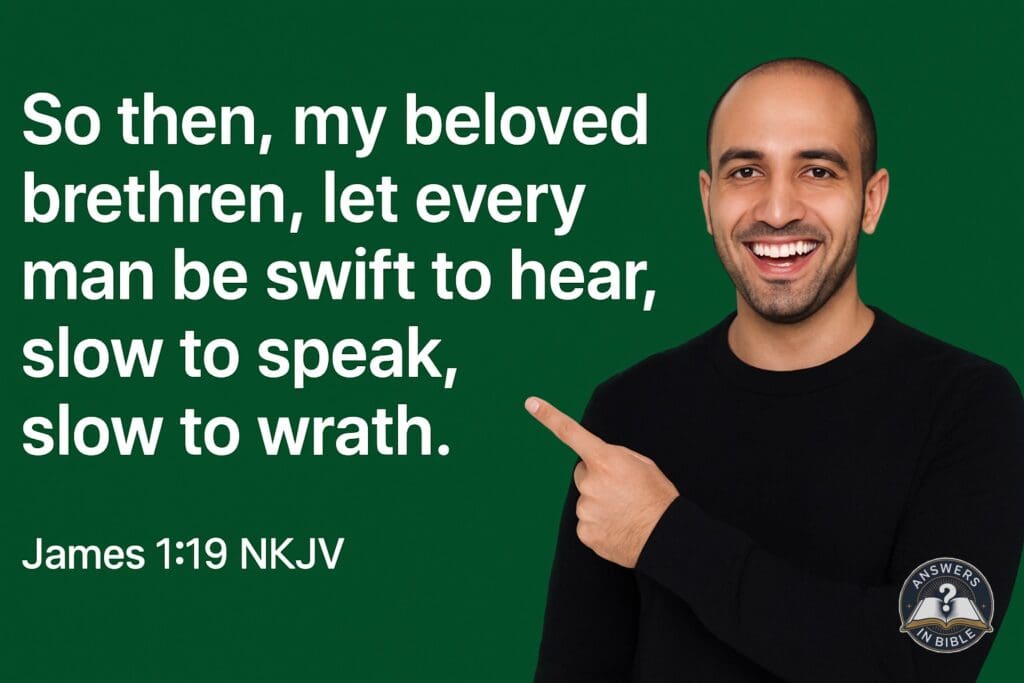
    Swift to Hear, Slow to Speak | James 1:19

    “So then, my beloved brethren, let every man be swift to hear, slow to speak, slow to wrath” (James 1:19, NKJV). Most of us run this exact order backwards, swift to speak, slow to actually hear, and quick to anger along the way.

    Swift to hear means genuinely listening, not just waiting for a pause to respond. That’s a rarer skill than it sounds.

    Slow to speak and slow to wrath aren’t about suppressing every reaction. They’re about creating space between what’s said to you and what comes out of you in response.

    In your next hard conversation, try flipping the usual order: listen first, longer than feels natural, before responding at all.