Tag: 1 Corinthians 13

  • What Is the Gift of Prophecy in the Bible?

    What Is the Gift of Prophecy in the Bible?

    The gift of prophecy in the Bible is a God-given ability to speak a message from God to his people. Many readers assume prophecy simply means predicting the future, but the New Testament describes something broader and more pastoral. This article looks at what Scripture says about the gift, and at the sincere disagreement among Christians about whether it continues today.

    What the Bible Means by Prophecy

    In the Old Testament, prophets such as Isaiah, Jeremiah, and Ezekiel spoke for God to Israel, calling the people back to faithfulness and sometimes foretelling what was coming. The New Testament carries that idea into the life of the church. Paul lists prophecy among the gifts of the Spirit in 1 Corinthians 12, alongside gifts like healing, discernment, and teaching.

    When Paul explains what the gift is for, he emphasizes people more than predictions: “But he that prophesieth speaketh unto men to edification, and exhortation, and comfort” (1 Corinthians 14:3). Prophecy, in this description, builds up, urges, and consoles. Paul even tells the Corinthians to “desire spiritual gifts, but rather that ye may prophesy” (1 Corinthians 14:1), because it strengthens the whole congregation.

    The New Testament also places the gift inside the life of the church. Ephesians 4:11-12 says Christ “gave some, apostles; and some, prophets; and some, evangelists; and some, pastors and teachers; for the perfecting of the saints, for the work of the ministry, for the edifying of the body of Christ.”

    Testing a Prophetic Word

    The Bible does not ask believers to accept every claimed message without question. Paul writes, “Despise not prophesyings. Prove all things; hold fast that which is good” (1 Thessalonians 5:20-21). Respect for the gift and careful testing go together. Most traditions agree that any prophetic message must be weighed against Scripture and judged by whether it points people toward Christ and builds up the church.

    Does the Gift of Prophecy Continue Today?

    Here sincere Christians part ways, and this site does not take a side. One view, often called continuationism, holds that the gifts of the Spirit, including prophecy, continue in the church today. Those who hold it point to passages like 1 Corinthians 12 and 14 and to the church’s ongoing need for encouragement and guidance. They typically say modern prophecy is fallible and must always be tested, and that it never adds to Scripture.

    The other view, often called cessationism, holds that prophecy and certain other gifts served a foundational role in the early church and have ceased now that the Bible is complete. Those who hold it often point to Ephesians 2:20, where the church is described as built on the foundation of the apostles and prophets, and to 1 Corinthians 13:8-10, where Paul says prophecies “shall fail” and speaks of a time “when that which is perfect is come.” Christians disagree about what that “perfect” thing is. Some understand it as the completed Scripture, and others as the return of Christ and the life to come.

    Many believers fall somewhere between these two positions, and thoughtful Christians in every tradition agree that love, humility, and faithfulness to Scripture matter more than any single gift. For the related discussion about tongues, see What Is the Gift of Tongues in the Bible?

    Key Bible Verses

    1 Corinthians 14:3
    “But he that prophesieth speaketh unto men to edification, and exhortation, and comfort.”

    1 Corinthians 13:8
    “Charity never faileth: but whether there be prophecies, they shall fail; whether there be tongues, they shall cease; whether there be knowledge, it shall vanish away.”

    Ephesians 4:11-12
    “And he gave some, apostles; and some, prophets; and some, evangelists; and some, pastors and teachers; for the perfecting of the saints, for the work of the ministry, for the edifying of the body of Christ.”

    Frequently Asked Questions

    Is the gift of prophecy only about predicting the future?

    No. Predicting events is one part of prophecy in the Old Testament, but 1 Corinthians 14:3 describes the New Testament gift as speaking to people for their edification, exhortation, and comfort.

    Is the gift of prophecy still active today?

    Christians answer this differently. Continuationists believe the gift continues, to be tested against Scripture, while cessationists believe it ended with the apostolic age. Both groups hold that no prophecy can add to or override the Bible.

    Related Bible Topics

    What Is the Gift of Tongues in the Bible? | What Are the Books of the Prophets in the Bible? | What Is Divination in the Bible?

    Ask a Deeper Question

    Have a specific question about spiritual gifts, prophecy, or the passages above? Ask below and get an instant, scripture-based answer.

  • Notable Quotes From Paul in the Bible

    Notable Quotes From Paul in the Bible

    Paul wrote more of the New Testament than any other author, and some of his lines have outlasted the centuries to become part of how Christians describe faith, love, and perseverance today. Best known as the apostle who carried the gospel across the Roman world through missionary journeys and letters to young churches, Paul wrote with a directness that still speaks plainly nearly two thousand years later. Here are some of his most quoted words, in their own context.

    Paul’s Words on Grace and Salvation

    Paul’s central theme, especially in his letter to the Ephesians, is that salvation is God’s gift rather than something earned. In Ephesians 2:8-9, he writes, “For by grace are ye saved through faith; and that not of yourselves: it is the gift of God: Not of works, lest any man should boast.” This one sentence anchors a large share of Christian teaching on grace, and Paul returns to the theme again and again throughout his letters.

    Paul’s Words on Love

    Paul’s description of love in his first letter to the Corinthians is quoted at weddings and funerals alike, by believers and skeptics both. In 1 Corinthians 13:4-7 he writes, “Charity suffereth long, and is kind; charity envieth not; charity vaunteth not itself, is not puffed up, doth not behave itself unseemly, seeketh not her own, is not easily provoked, thinketh no evil; rejoiceth not in iniquity, but rejoiceth in the truth; beareth all things, believeth all things, hopeth all things, endureth all things.” “Charity” here translates the Greek word agape, self-giving love, the same word most modern translations simply render as “love.”

    Paul’s Words on Strength in Weakness

    Paul wrote from real hardship: imprisonment, shipwreck, and an unnamed “thorn in the flesh” he asked God three times to remove. In 2 Corinthians 12:9 he records God’s answer, “My grace is sufficient for thee: for my strength is made perfect in weakness. Most gladly therefore will I rather glory in my infirmities, that the power of Christ may rest upon me.” That same confidence shows up in Philippians 4:13, written from prison, “I can do all things through Christ which strengtheneth me.” Read in its full context, the verse follows Paul describing how he had learned to be content whether he had plenty or little, not a promise of success in any endeavor a reader chooses.

    Paul’s Words on Finishing Well

    Near the end of his life, writing to his protege Timothy, Paul looked back with a settled confidence rather than fear. In 2 Timothy 4:7 he writes, “I have fought a good fight, I have finished my course, I have kept the faith.” That same sense of a life fully given over to Christ appears earlier in Galatians 2:20, “I am crucified with Christ: nevertheless I live; yet not I, but Christ liveth in me: and the life which I now live in the flesh I live by the faith of the Son of God, who loved me, and gave himself for me.”

    Key Bible Verses

    Philippians 4:13
    “I can do all things through Christ which strengtheneth me.”

    2 Corinthians 12:9
    “And he said unto me, My grace is sufficient for thee: for my strength is made perfect in weakness. Most gladly therefore will I rather glory in my infirmities, that the power of Christ may rest upon me.”

    2 Timothy 4:7
    “I have fought a good fight, I have finished my course, I have kept the faith.”

    Frequently Asked Questions

    Who was Paul in the Bible?

    Paul, originally named Saul, was a Pharisee who persecuted the early church before encountering the risen Jesus on the road to Damascus (Acts 9:1-19). After that encounter he became one of the most influential missionaries and writers in the early church, planting churches across the Roman Empire.

    How many books of the Bible did Paul write?

    Paul is traditionally credited with writing thirteen New Testament letters, from Romans to Philemon, addressed to churches and individuals he knew personally.

    Related Bible Topics

    What Are the Epistles in the Bible? | What Does Philippians 4:13 Mean? | What Does Faith Without Works Mean?

    Ask a Deeper Question

    Have a specific question about Paul or one of his letters? Ask below and get an instant, scripture-based answer.

  • Love Suffers Long and Is Kind | 1 Corinthians 13:4

    Love Suffers Long and Is Kind | 1 Corinthians 13:4

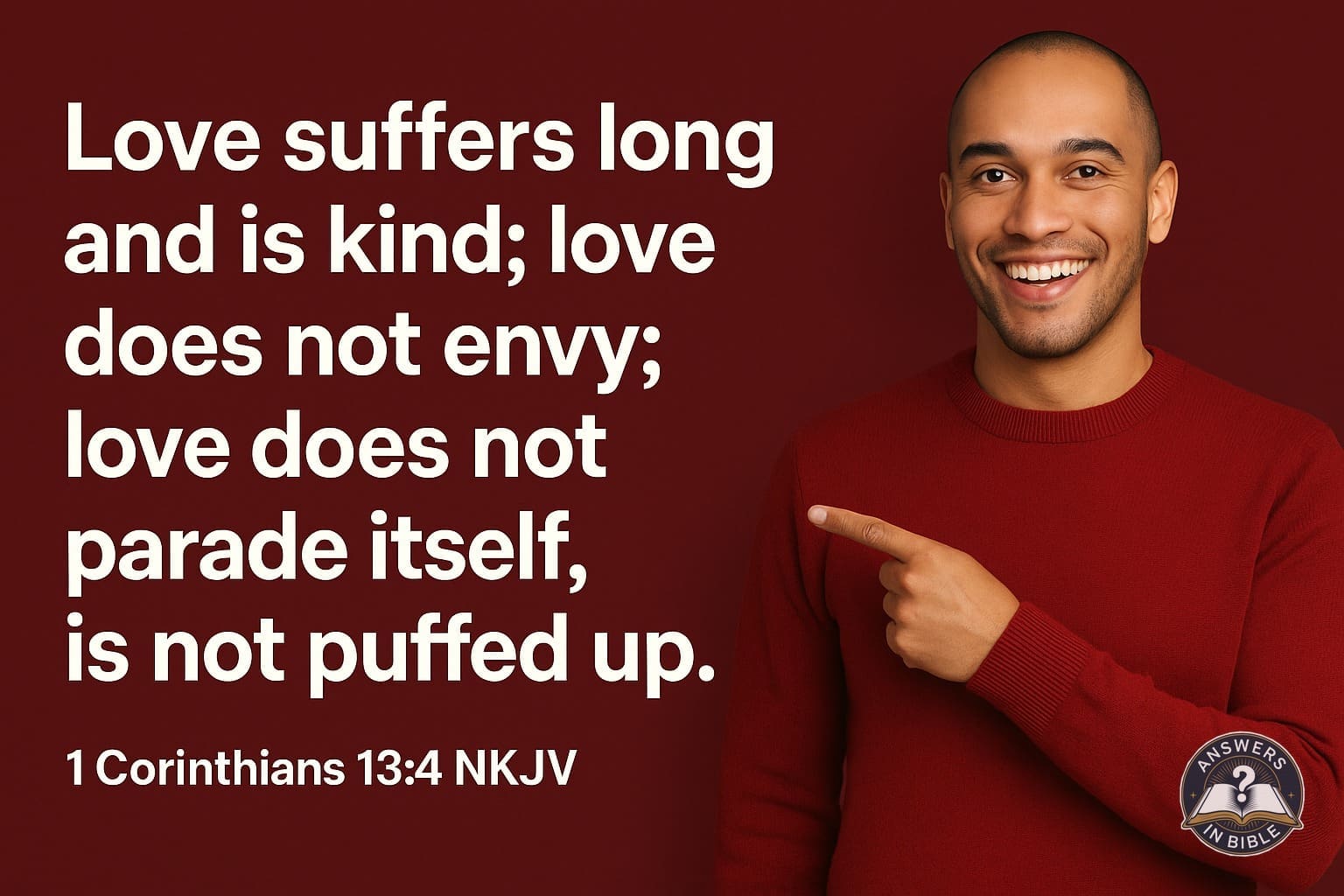
    “Love suffers long and is kind; love does not envy; love does not parade itself, is not puffed up” (1 Corinthians 13:4, NKJV). On a day full of cards and flowers, it’s worth remembering that Scripture’s most famous description of love isn’t about romance at all. It’s about character.

    Suffers long, meaning patient, willing to endure without giving up. Kind, meaning actively good toward the other person, not just tolerant of them. This is a far more demanding definition than the feeling most of us associate with the word.

    Notice what’s absent from love as described here: envy, self-promotion, pride. This is a love turned outward, not a love that uses another person to feel good about itself.

    Whoever you’re celebrating today, this verse is a good measure to hold up against the relationship. Not does it feel romantic, but does it look like this.