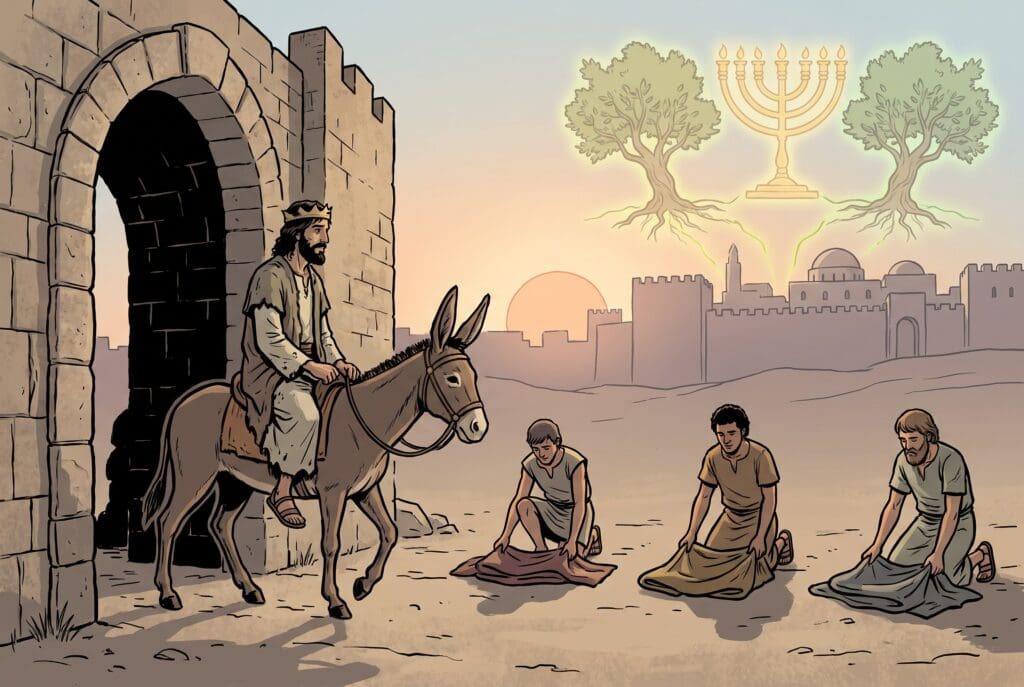
Zechariah
Themes
Encouragement to complete the temple's rebuilding through God's Spirit rather than human strength, a series of symbolic night visions revealing God's ongoing care for His people, and an unusually rich collection of Messianic prophecies pointing forward to a coming humble king, a pierced shepherd, and God's ultimate reign over all the earth.
Original Language
Hebrew
Introduction
Zechariah prophesied alongside Haggai to the same returned exile community working to rebuild Jerusalem's temple, but where Haggai's message is direct and practical, Zechariah's is rich with symbolic night visions, apocalyptic imagery, and forward-looking prophecy. The book opens with eight visions in a single night, each addressing different aspects of God's care and plans for the restored community, followed by extended oracles looking toward Jerusalem's future.
Zechariah contains an unusually concentrated collection of prophecies that the New Testament connects directly to Jesus: a king coming to Jerusalem humble and riding on a donkey, a shepherd struck so the sheep scatter, thirty pieces of silver thrown to a potter, and 'they will look on me, the one they have pierced.' The book closes with a sweeping vision of a final Day of the LORD when God Himself will reign as king over all the earth. Zechariah shows how a specific, practical moment, rebuilding a temple, connects to God's much larger redemptive plan across history.
For Teachers & Pastors: A Closer Look
Zechariah began prophesying in the eighth month of Darius I's second year (520 BC, 1:1), roughly two months after Haggai's first message, and continued at least into Darius's fourth year (518 BC, 7:1), working alongside Haggai to encourage completion of the temple (Ezra 5:1-2, 6:14), which was finished in 516 BC. The book divides into two major sections with distinct character: chapters 1-8 contain eight symbolic night visions (horsemen among myrtle trees, four horns and four craftsmen, a man with a measuring line, Joshua the high priest's filthy garments exchanged for clean ones, the golden lampstand and two olive trees, the flying scroll, the woman in a basket, and four chariots) plus messages on fasting and future restoration, largely addressed to the immediate post-exilic community.
Chapters 9-14, often called 'Second Zechariah' by scholars due to a shift in style and historical setting, contain two extended oracles largely focused on the future: chapter 9 includes the prophecy of a king coming to Zion 'righteous and having salvation, humble and mounted on a donkey' (9:9), fulfilled in the Gospels' accounts of Jesus's triumphal entry (Matthew 21:5, John 12:15); chapter 11 describes a rejected shepherd paid thirty pieces of silver, thrown to the potter, connected to Judas's betrayal in Matthew 27:9-10; chapter 12:10 contains 'they will look on me, the one they have pierced,' quoted in John 19:37 regarding the crucifixion; and chapter 13:7 describes a shepherd struck so the sheep scatter, which Jesus applies to Himself and the disciples in Matthew 26:31. The book closes (chapter 14) with a vision of the final Day of the LORD, when the LORD's feet stand on the Mount of Olives, living waters flow from Jerusalem, and the LORD becomes king over all the earth.
