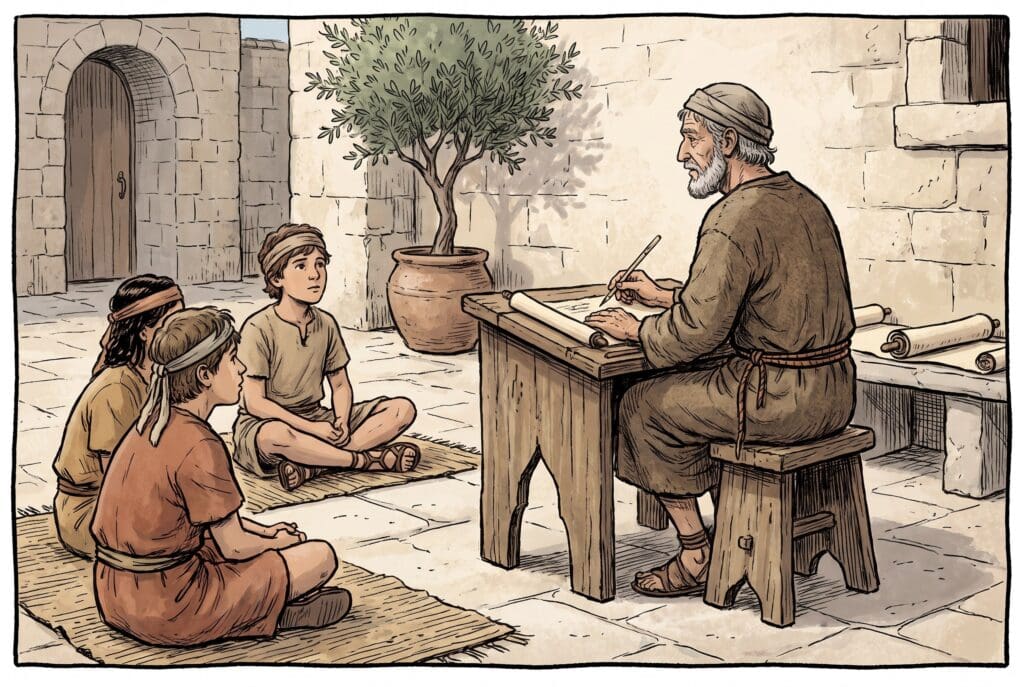
Sirach (Ecclesiasticus)
Themes
The fear of the LORD as the beginning and foundation of true wisdom; practical guidance for daily life covering friendship, family, speech, wealth, work, and humility; the identification of wisdom with the Law of Moses and its presence within Israel; the value of honoring parents, teachers, physicians, and the wise; and an extended closing tribute honoring the great figures of Israel's history.
Original Language
Hebrew (translated into Greek by the author's grandson)
Introduction
Sirach, also known as Ecclesiasticus, is an extensive collection of practical wisdom teaching, similar in style to Proverbs but far more extensive, covering nearly every area of daily life: friendship, family relationships, table manners, business dealings, honest speech, humility, discipline of children, care for the poor, and proper worship. Throughout, the book insists that genuine wisdom begins with reverence for God, 'the fear of the LORD,' and cannot be separated from a life of practical righteousness.
A distinctive contribution of the book comes in chapter 24, where wisdom, personified as calling out to all people, explicitly identifies herself with the Law given to Moses, teaching that Israel's Scripture itself is the concrete, accessible form wisdom takes in the world. The book closes with an extended, celebratory tribute to Israel's great figures across history, from Enoch and Noah through the prophets and priests, concluding with reflections from the author himself, a Jerusalem scribe named Jesus (Yeshua) son of Sirach.
For Teachers & Pastors: A Closer Look
Sirach (also called Ecclesiasticus, 'the Church's book,' composed originally in Hebrew around 180 BC by a Jerusalem scribe named Jesus son of Sirach, and translated into Greek by his grandson roughly fifty years later, whose prologue explaining this translation is preserved as an introduction to the book; accepted as canonical Scripture by the Catholic Church and Eastern Orthodox Church) is the longest wisdom book in the biblical or deuterocanonical corpus, and among the relatively few deuterocanonical books for which substantial portions of the original Hebrew text have actually survived, discovered among the Dead Sea Scrolls and the Cairo Genizah manuscripts, allowing scholars unusually direct access to compare the Hebrew original against the Greek translation.
Structurally, the book resembles an extended anthology of proverbs and short discourses on a wide range of practical and ethical topics, culminating in the striking identification of Wisdom with Torah in chapter 24 ('all this is the book of the covenant of the Most High God, the law that Moses commanded us') and closing with the 'Praise of the Ancestors' (ch. 44-50), an extended honorific survey of Israel's major historical figures that has significantly influenced later Jewish and Christian traditions of biblical hall-of-fame literature (compare Hebrews 11).
