Matthew
Themes
Jesus as the promised Jewish Messiah and fulfillment of Old Testament prophecy, the Kingdom of Heaven, the Sermon on the Mount and Jesus's ethical teaching, Jesus's authority through miracles and teaching, conflict with religious leaders, and the Great Commission to make disciples of all nations.
Original Language
Greek (Koine)
Introduction
Matthew is the first of the four Gospels and was written especially with a Jewish audience in mind. It repeatedly shows how Jesus fulfills promises made throughout the Old Testament, quoting Hebrew Scripture more than any other Gospel to make that connection clear.
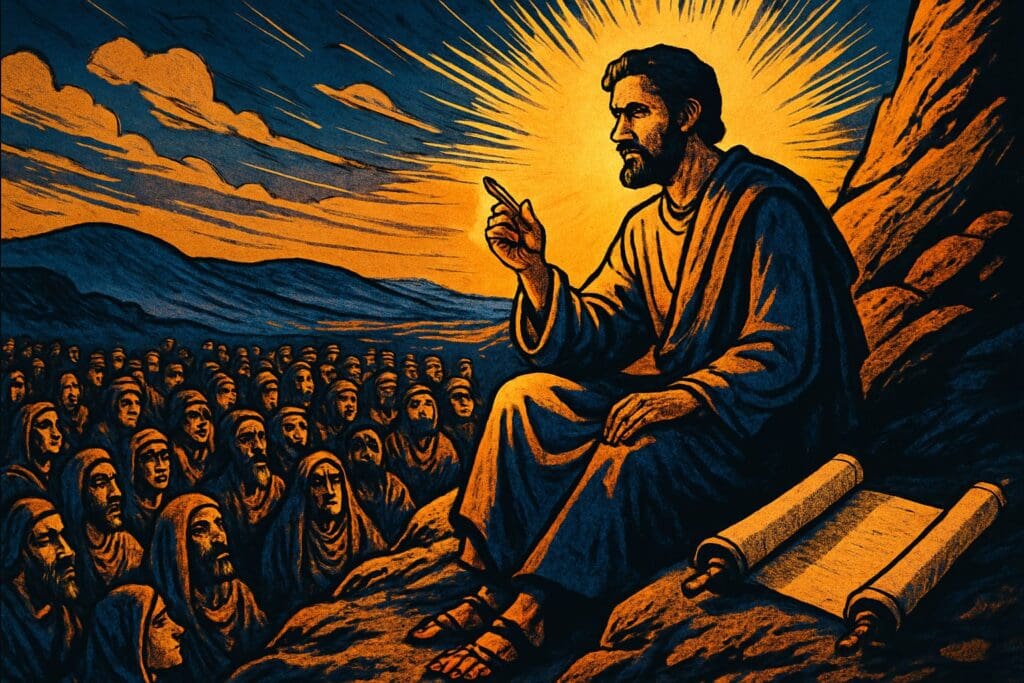
The book opens with Jesus's genealogy and birth, then follows His ministry: His baptism, the famous Sermon on the Mount (chapters 5-7), His miracles and teaching in parables, His growing conflict with religious leaders, and finally His arrest, crucifixion, and resurrection. Matthew closes with the Great Commission - Jesus sending His followers to make disciples of all nations, promising to be with them always.
For Teachers & Pastors: A Closer Look
Matthew is traditionally attributed to the apostle Matthew (also called Levi), a former tax collector, though questions of authorship, sources, and dating are actively discussed in modern scholarship, including Matthew's literary relationship to Mark and a hypothesized shared sayings source often labeled Q. Structurally, the Gospel is often read as organized around five major discourses (chapters 5-7, 10, 13, 18, 24-25), each closing with a formulaic transition ("when Jesus had finished..."), possibly echoing the five books of the Torah and reinforcing Matthew's presentation of Jesus as a new, greater Moses-like lawgiver.
Matthew's fulfillment citations ("this was to fulfill what was spoken by the prophet...") are a distinctive feature, occurring more than a dozen times and reflecting the Gospel's strong interest in continuity with Israel's Scriptures. The Sermon on the Mount (5-7) is Matthew's most extensive block of ethical teaching and has generated substantial interpretive discussion regarding its relationship to Mosaic law (5:17-20) and its function as either a strict ethical code, an eschatological ideal, or both. Teachers and pastors should also note Matthew's distinctive emphasis on the Church (using the Greek term ekklesia, absent from the other Gospels, in 16:18 and 18:17) and its climactic Great Commission (28:18-20), which frames the whole Gospel's missionary trajectory.
