Mark
Themes
Jesus as the suffering Servant and Son of God revealed through action more than long discourse, the urgency and immediacy of Jesus's ministry, the authority of Jesus over sickness, demons, nature, and death, the true cost of discipleship, and the necessity of the cross.
Original Language
Greek (Koine)
Introduction
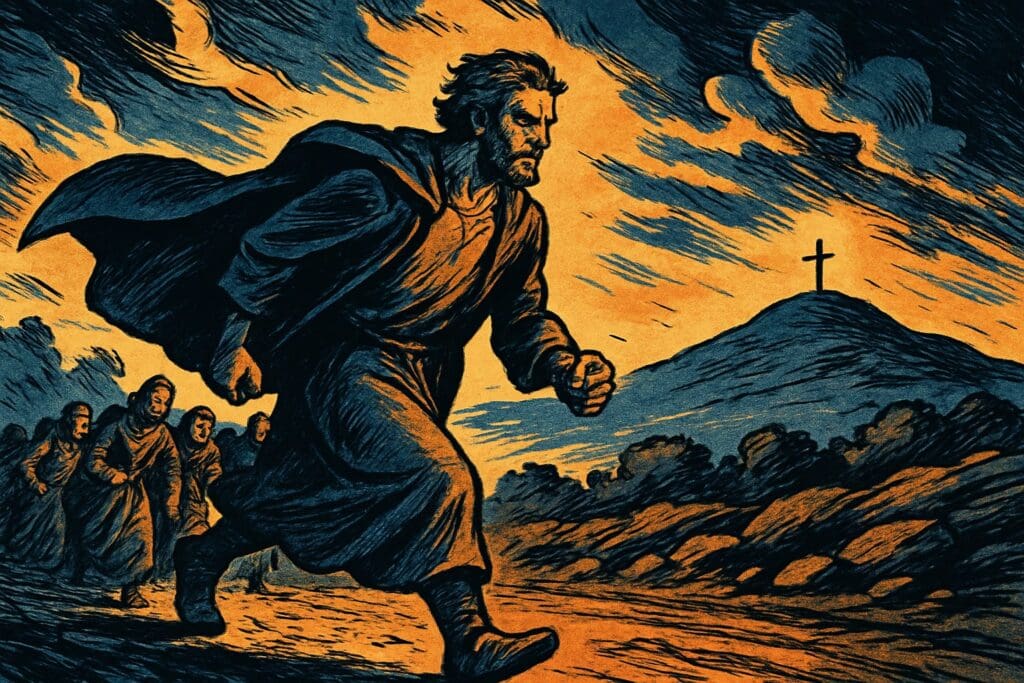
Mark is the shortest and fastest-paced of the four Gospels, often moving from one event to the next with the word "immediately." Rather than spending much time on long teaching sections, Mark shows who Jesus is mainly through what He does - His miracles, His authority over evil spirits and nature, and ultimately His willingness to suffer and die.
Mark is traditionally understood to be closely connected to the apostle Peter's own eyewitness account, giving the book a vivid, on-the-ground feel. About a third of the book is devoted to the final week of Jesus's life, underscoring how central the cross is to Mark's message. The Gospel presents Jesus not just as a powerful teacher, but as the Son of God who came, in His own words, "to give his life as a ransom for many" (10:45).
For Teachers & Pastors: A Closer Look
Mark is widely regarded by most modern scholars as the earliest of the four canonical Gospels and a likely source used by both Matthew and Luke (the "Markan priority" hypothesis within Synoptic Gospel source criticism). Early church tradition (attested by Papias, via Eusebius) connects Mark's Gospel closely to the preaching of the apostle Peter, with Mark serving as Peter's interpreter/amanuensis - a tradition consistent with the Gospel's vivid, detail-rich, action-oriented narrative style.
Mark's favored connective, euthys ("immediately"), occurs more than forty times and contributes to the book's characteristic sense of urgency. The Gospel is also noted for its "messianic secret" motif, in which Jesus repeatedly commands demons, healed individuals, and even His own disciples not to disclose His identity prematurely (e.g. 1:34, 1:44, 8:30), a literary/theological feature that has generated substantial scholarly discussion regarding Mark's Christology and narrative strategy. Structurally, the Gospel pivots at Peter's confession in 8:29, after which the narrative turns decisively toward Jerusalem and the passion, with roughly a third of the total book devoted to the final week of Jesus's life (chapters 11-16) - a proportion that has led some scholars to describe Mark as fundamentally a passion narrative with an extended introduction.
