Lamentations
Themes
Grief and lament over Jerusalem's destruction, honest processing of suffering and loss, God's justice in judgment, and hope for God's mercy and faithfulness even in the depths of sorrow.
Original Language
Hebrew
Introduction
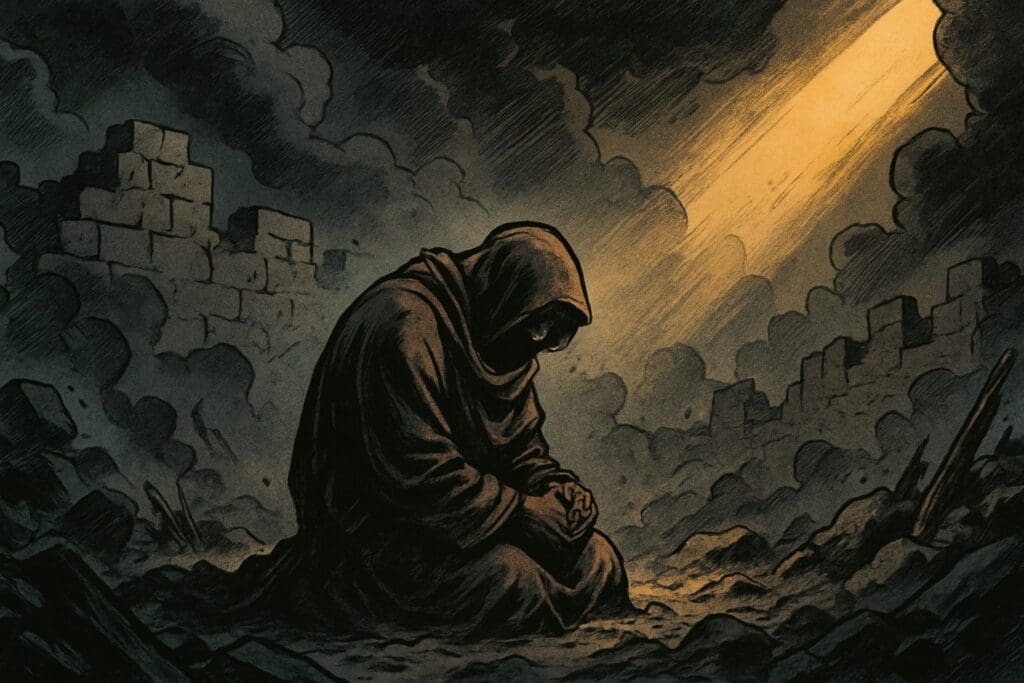
Lamentations is a short but intense book of poetry mourning the destruction of Jerusalem and its temple by the Babylonians in 586 BC. Traditionally attributed to the prophet Jeremiah, who witnessed the city's fall firsthand, the book gives voice to raw, unfiltered grief: starving children, fallen leaders, a ruined temple, and a people left wondering if God had abandoned them entirely.
What makes Lamentations remarkable is that it doesn't rush past the pain to get to a tidy resolution. Four of its five chapters are written as acrostic poems, each line beginning with a successive letter of the Hebrew alphabet, a literary structure suggesting a complete, exhaustive expression of grief, working through sorrow from A to Z. Yet right at the book's emotional center, in chapter 3, come some of the most quoted words of hope in the Old Testament: God's mercies are new every morning, and His faithfulness is great. Lamentations models how to hold devastating loss and genuine hope together, honestly.
For Teachers & Pastors: A Closer Look
Lamentations is traditionally attributed to Jeremiah, and the book is positioned immediately after Jeremiah in most Christian Bible orderings (though it appears among the Writings in the Hebrew Bible, read liturgically on the Ninth of Av to commemorate the temple's destruction). The book consists of five poems: chapters 1, 2, and 4 are acrostics with 22 verses each corresponding to the 22 letters of the Hebrew alphabet; chapter 3 is a triple acrostic with 66 verses (three verses per letter), making it the structural and theological center of the book; and chapter 5, while not a formal acrostic, has exactly 22 verses, echoing the pattern one final time.
This acrostic structure is widely understood as a literary device conveying totality and completeness, expressing the full range of grief from beginning to end, while also imposing a kind of controlled, disciplined form onto overwhelming chaos and sorrow. The book is written primarily as a qinah or funeral dirge, using a distinctive limping meter common to ancient Near Eastern laments. Despite its unrelenting honesty about suffering and even framing some of it as God's own judgment against Jerusalem's unfaithfulness, the book's theological center in chapter 3:22-24 (God's mercies being new every morning) has made it a vital resource for processing grief throughout Jewish and Christian tradition alike, demonstrating that lament and hope are not mutually exclusive responses to suffering.
