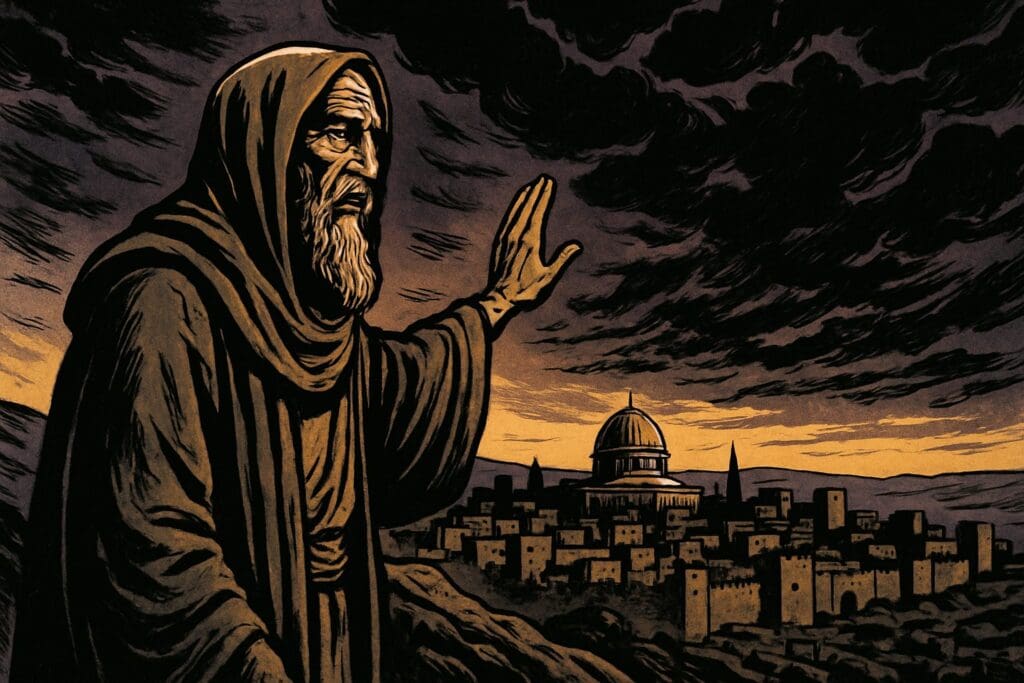
Jeremiah
Themes
God's patient warning before judgment, the pain of a prophet called to deliver a message no one wants to hear, the consequences of persistent unfaithfulness, and the enduring promise of a future new covenant and restoration beyond exile.
Original Language
Hebrew
Introduction
Jeremiah is one of the longest and most personal books in the Old Testament, giving readers an unusually intimate look at the life of a prophet. Called by God as a young man, Jeremiah ministered in Jerusalem's final decades before the Babylonians destroyed the city and temple in 586 BC, faithfully warning kings and priests alike that judgment was coming because of the nation's persistent idolatry and injustice, even though almost no one listened.
What sets Jeremiah apart is how honestly it records the prophet's own struggle: he wept over the message he had to deliver, was mocked, imprisoned, and thrown into a cistern for his warnings, and repeatedly poured out raw complaints to God about the cost of his calling. Yet woven through this book of judgment is one of Scripture's clearest promises of hope: a coming new covenant, written on the heart rather than on stone, in which God's people would finally know Him fully. Jeremiah shows that faithfulness to God's calling can be both painful and purposeful at the same time.
For Teachers & Pastors: A Closer Look
Jeremiah ministered from roughly 627 BC (the thirteenth year of King Josiah) through the fall of Jerusalem in 586 BC and into the early exile in Egypt, spanning the reigns of five Judean kings and the most turbulent final decades of the southern kingdom. The book is not arranged in strict chronological order; instead it interweaves oracles of judgment against Judah (chapters 1-25), narrative accounts of the prophet's conflicts with kings, priests, and false prophets (chapters 26-45), oracles against foreign nations (chapters 46-51), and a closing historical appendix describing the fall of Jerusalem (chapter 52, largely paralleling 2 Kings 24-25).
Jeremiah's scribe Baruch recorded and preserved much of the book's material (Jeremiah 36), and the book contains some of the most personal material of any prophetic book, including the so-called "confessions of Jeremiah" (passages such as 11:18-23, 15:10-21, 20:7-18) in which the prophet laments the cost of his calling with striking candor. Chapters 30-33, often called the "Book of Consolation," contain the book's central promise of restoration, including the explicit new covenant promise in 31:31-34, later cited directly in Hebrews 8 as fulfilled in Christ. Jeremiah's warnings about Babylon's seventy-year exile (25:11-12, 29:10) also became a key text for later prophets and for Daniel's own reflection on the timing of Israel's restoration (Daniel 9:2).
