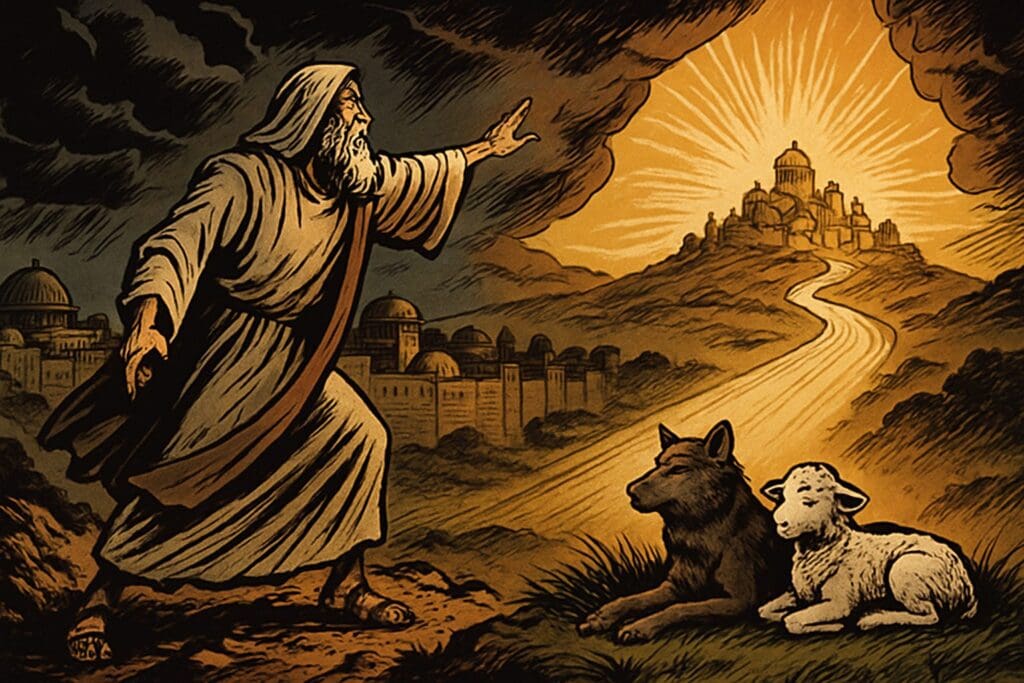
Isaiah
Themes
God's holiness and judgment against sin, warnings against trusting foreign alliances instead of God, the coming judgment and eventual restoration of Israel and Judah, God's sovereignty over all nations, and rich, detailed prophecies of a coming Messiah who would suffer for His people and establish everlasting peace and justice.
Original Language
Hebrew
Introduction
Isaiah is the longest of the prophetic books, written by a prophet who ministered in Jerusalem across the reigns of four kings during a turbulent era of Assyrian threat and eventual Babylonian conquest. The book opens with strong warnings: Judah's worship had become empty ritual disconnected from genuine justice and care for the vulnerable, and both Judah and the surrounding nations would face God's judgment for pride and unfaithfulness. Isaiah pairs these warnings with a call to trust God rather than political alliances with Egypt or Assyria for security.
But Isaiah is just as famous for its hope as its warnings. It contains some of the Bible's most treasured promises: a child called Immanuel, a shoot from the stump of Jesse who would rule with wisdom and justice, and, in its second half, extended poems describing a suffering servant who would be pierced for others' transgressions and carry the weight of their sin. The book closes with a vision of new heavens and a new earth, God's judgment against evil finally complete and His people living in lasting peace, making Isaiah a book that moves from sobering warning to soaring hope.
For Teachers & Pastors: A Closer Look
Isaiah ministered in Jerusalem from roughly 740 to 680 BC, spanning the reigns of Uzziah, Jotham, Ahaz, and Hezekiah, a period that saw the Assyrian empire destroy the northern kingdom of Israel (722 BC) and threaten Jerusalem itself under Sennacherib (701 BC). Scholars have long debated the book's authorship and unity, particularly regarding chapters 40-66, which address a later Babylonian exile setting; whether this reflects a single author writing prophetically forward in time, a later continuation of Isaiah's prophetic tradition, or some combination remains a significant point of scholarly discussion, though the book stands as a unified whole in its final canonical form and is treated that way in Jewish and Christian tradition alike.
The book is often divided into three broad sections: judgment oracles against Judah and the nations (chapters 1-39, including the historical narrative of Hezekiah's reign in chapters 36-39), and two sections of comfort and restoration often called Isaiah's "Book of Comfort" (chapters 40-55, focused on release from exile and the servant songs) and a final section addressing post-exilic concerns and eschatological hope (chapters 56-66). The four "Servant Songs" (notably 42:1-9, 49:1-13, 50:4-11, and 52:13-53:12) are among the most theologically significant passages in the Old Testament, and Isaiah 53's description of a suffering servant "pierced for our transgressions" is quoted extensively in the New Testament as pointing to Jesus. Isaiah is quoted or alluded to in the New Testament more than almost any other Old Testament book, reflecting its enormous influence on early Christian understanding of the Messiah.
