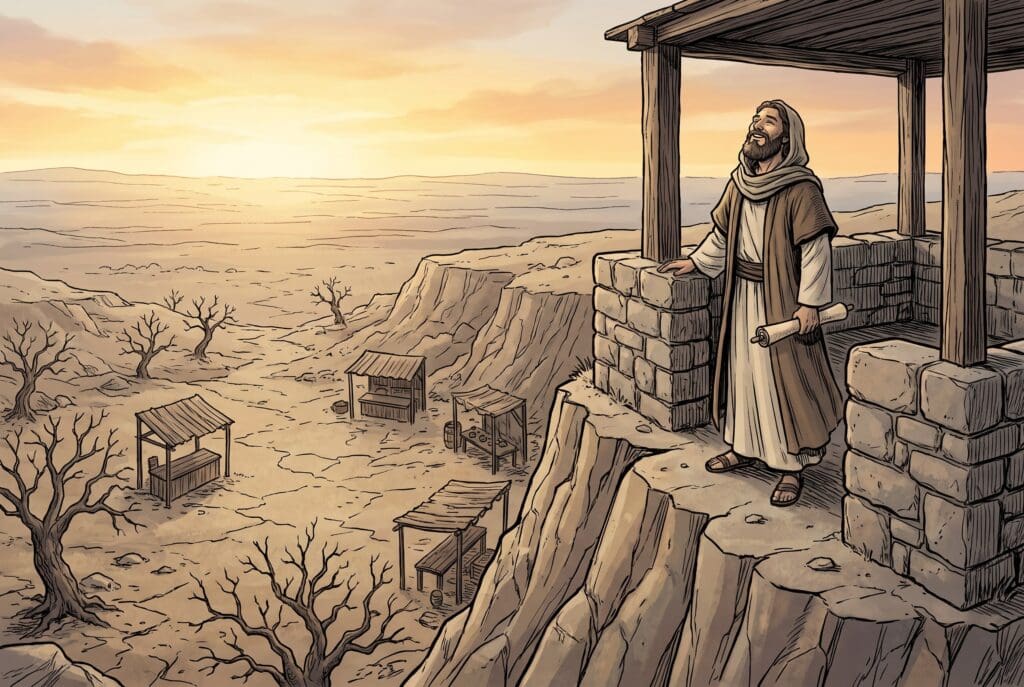
Habakkuk
Themes
Honest wrestling with God over unanswered injustice, trusting God's sovereignty even when His methods are hard to understand, righteousness by faith rather than by resolved circumstances, and worship and joy that persist even when every visible reason for it disappears.
Original Language
Hebrew
Introduction
Habakkuk is unlike most prophetic books in that it isn't primarily a message to the people, it's a conversation between the prophet and God. Habakkuk opens by honestly confronting God with a hard question: why does He tolerate injustice and violence in Judah without answering? God's response is even harder to hear: He is raising up the brutal Babylonians to bring judgment, using a nation more wicked than Judah to punish Judah's sin.
Habakkuk pushes back a second time, and God's ultimate answer isn't a full explanation but a call to trust: 'the righteous shall live by his faith,' a phrase later foundational to the New Testament's teaching on salvation by faith. The book closes with one of Scripture's most remarkable declarations of worship, Habakkuk choosing to rejoice in God even while describing total agricultural and economic collapse, modeling faith that isn't dependent on circumstances lining up first.
For Teachers & Pastors: A Closer Look
Habakkuk's prophecy is dated to shortly before the Babylonian (Chaldean) invasion of Judah, likely in the final years of the 7th century BC (around 605-597 BC), given that God's answer in 1:5-11 describes the Babylonians as a rising but not-yet-arrived threat. Unlike other prophetic books structured as messages to the people, Habakkuk is structured as a dialogue: the prophet's first complaint about injustice within Judah (1:2-4), God's unsettling answer (1:5-11), the prophet's second complaint about using a more wicked nation to judge a less wicked one (1:12-2:1), and God's fuller answer (2:2-20), including the pivotal statement in 2:4, 'the righteous shall live by his faith,' quoted in Romans 1:17, Galatians 3:11, and Hebrews 10:38 as foundational to New Testament teaching on justification by faith.
Chapter 2 also contains a series of five 'woe' oracles against the coming oppressor (Babylon), condemning unjust gain, violence, exploitation, and idolatry, and includes the declaration that 'the earth will be filled with the knowledge of the glory of the LORD, as the waters cover the sea' (2:14). Chapter 3 is a psalm-like prayer (with musical notations similar to those found in the Psalms) recalling God's past deliverance in vivid theophanic imagery, before closing with Habakkuk's declaration of faith and joy in God despite total agricultural failure (3:17-19), widely regarded as one of the most striking expressions of faith independent of circumstances in the Old Testament.
