Ezekiel
Themes
The glory and holiness of God, judgment on Jerusalem and the nations for covenant unfaithfulness, individual responsibility before God, vivid symbolic visions (the wheels, the valley of dry bones, the new temple), and God's promise to restore Israel and dwell among His people with a new heart and a new spirit.
Original Language
Hebrew
Introduction
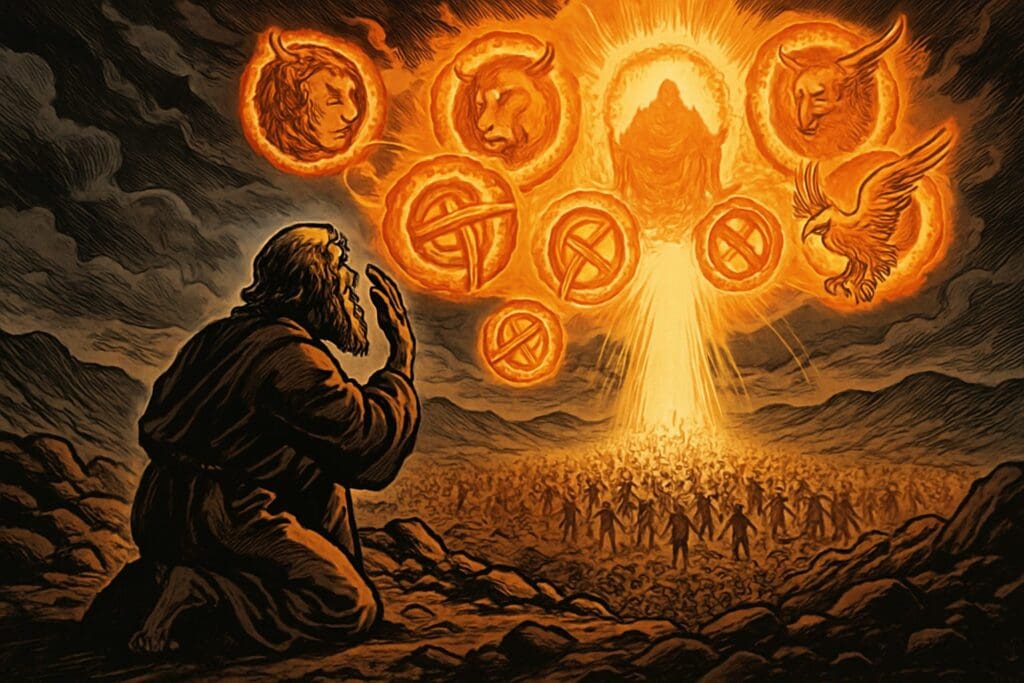
Ezekiel was a priest living among the Jewish exiles in Babylon after Jerusalem's people were carried away captive. God called him to be a prophet through one of the most overwhelming visions in the Bible: wheels within wheels, four living creatures, and a throne of dazzling glory. From there, Ezekiel spends much of the book warning that Jerusalem's fall wasn't bad luck, it was judgment for persistent unfaithfulness, and every person is accountable for their own choices, not just their ancestors'.
The book uses strange, memorable pictures to make its point: Ezekiel acts out a siege with a model of a city, lies on his side for over a year, and later stands in a valley of dry bones that God breathes back to life, a picture of hope for a nation that feels utterly dead. After Jerusalem actually falls in chapter 33, the tone shifts from judgment to restoration. God promises to gather His scattered people, give them a new heart and a new spirit, and dwell among them again, described in the book's closing vision of a magnificent new temple with a river flowing from it that brings life wherever it goes.
For Teachers & Pastors: A Closer Look
Ezekiel ministered among the exiles in Babylon (starting around 593 BC, five years before Jerusalem's final fall in 586 BC), making him a contemporary of Jeremiah, who prophesied in Jerusalem itself during the same period. The book is carefully structured in three movements: judgment on Judah and Jerusalem (chapters 1-24), judgment on surrounding nations (chapters 25-32), and restoration and hope after Jerusalem's fall (chapters 33-48), with chapter 33's news of the city's fall marking the hinge point.
Ezekiel's prophetic style is unusually visual and physical, heavy use of symbolic acts (siege models, shaving his head, packing an exile's bag), long allegories (the unfaithful wife in chapter 16, the two eagles and the vine in chapter 17), and apocalyptic imagery (the throne-chariot vision in chapter 1, Gog and Magog in chapters 38-39) that would later influence Jewish and Christian apocalyptic literature, including Revelation. The famous valley of dry bones (chapter 37) and the closing vision of the new temple with its life-giving river (chapters 40-48) are among the most theologically significant passages in the Old Testament, pointing forward to themes of resurrection, the Spirit's indwelling presence, and God dwelling permanently among His people.
