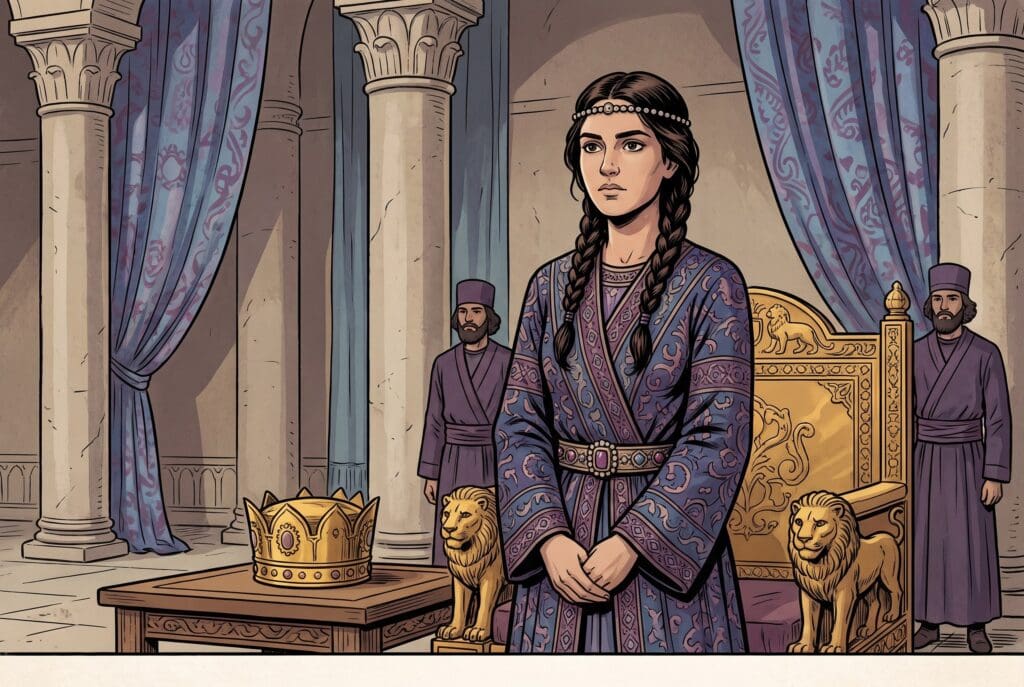
Esther
Themes
God's hidden, providential care for His people even when His name is never directly mentioned, courage in the face of real danger, the reversal of fortunes for the faithful and the wicked, and the way ordinary faithfulness in a difficult, compromised position can become the means of extraordinary deliverance.
Original Language
Hebrew
Introduction
Esther tells the story of a Jewish orphan girl who becomes queen of the vast Persian Empire, and who finds herself uniquely positioned to save her people from a planned genocide. Set among the Jews who remained scattered across the Persian Empire after the exile rather than returning to Jerusalem, the book follows Esther and her cousin Mordecai as they navigate the dangerous, glittering world of the royal court, where one official's wounded pride threatens to destroy an entire people.
What makes Esther unique among all the books of the Bible is that God's name never once appears in it, and yet His fingerprints are everywhere: in a queen's fall from favor that opens a door, in a sleepless night that changes a king's mind, in "coincidences" stacked so precisely that they can only be providence. Esther's famous choice, to risk her life advocating for her people "for such a time as this," has encouraged readers for centuries to trust that God is actively at work even in seasons when He seems silent or hidden.
For Teachers & Pastors: A Closer Look
Esther is set during the reign of the Persian king Ahasuerus (widely identified with Xerxes I, who ruled 486-465 BC), placing the events roughly a generation after the first wave of Jewish exiles returned to Jerusalem under Zerubbabel and decades before Ezra and Nehemiah's later reforms there; the book gives a window into the much larger Jewish population that remained scattered throughout the Persian Empire rather than returning to the land. Esther is one of only two biblical books (alongside Song of Solomon) that never explicitly mentions God's name, a literary choice scholars have long noted seems deliberate, letting the narrative itself demonstrate providence through a chain of "coincidences" rather than direct divine statement or intervention.
The book explains the origin of the Jewish festival of Purim, still celebrated annually, commemorating the reversal from Haman's planned genocide (cast by lot, or "pur") to the Jews' deliverance and triumph over their enemies. The Greek Septuagint version of Esther contains substantial additional material not found in the Hebrew text, including explicit prayers and direct references to God, material later collected as the deuterocanonical "Additions to Esther" in Catholic and Orthodox Bibles; Protestant Bibles, including the translations used on this site, follow the shorter Hebrew Masoretic Text. Mordecai's refusal to bow to Haman (chapter 3) and Esther's courageous approach to the king uninvited (chapter 4-5) form the narrative's central turning points, with Esther's declaration "if I perish, I perish" standing as one of Scripture's most quoted expressions of costly courage.
