Ephesians
Themes
God's eternal plan of salvation and adoption, the church as the unified body of Christ, unity between Jews and Gentiles, walking worthy of one's calling, the armor of God, and practical instructions for marriage, family, and daily Christian living.
Original Language
Koine Greek
Introduction
Ephesians is one of Paul's richest and most doctrinally dense letters, written to the church in Ephesus (and likely intended as a circular letter for surrounding churches as well), exploring the depth of God's eternal plan of salvation and its practical implications for how believers live together.
Paul opens with soaring praise for God's plan, chosen before the foundation of the world, adopting believers as His children, redeeming them through Christ's blood, and sealing them with the Holy Spirit. He prays that believers would grasp the incredible hope, riches, and power available to them in Christ.
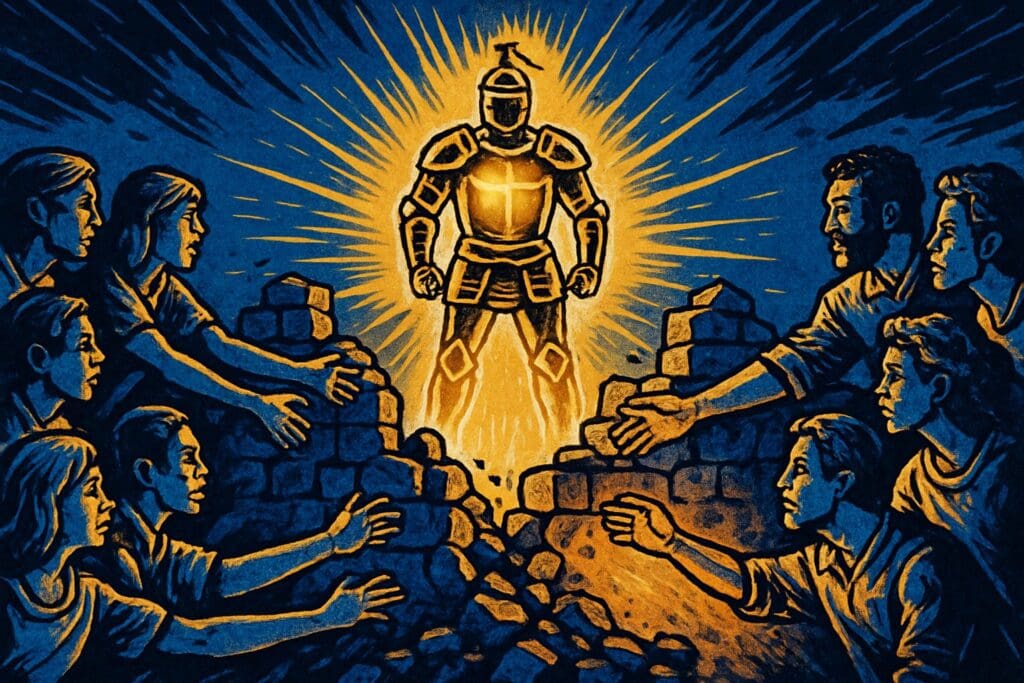
A major theme of the letter is unity, particularly the breaking down of the wall of hostility between Jews and Gentiles, who are now united together as one body, one new humanity, in Christ. Paul describes the church as Christ's body, growing and being built up together in love.
The second half of the letter turns practical, urging believers to walk worthy of their calling through humility, unity, and holy living, giving specific instructions for relationships within marriage, family, and work. The letter closes with the famous image of the armor of God, equipping believers to stand firm against spiritual opposition.
For Teachers & Pastors: A Closer Look
Ephesians shares substantial material and structure with Colossians (leading some scholars to view them as companion letters, likely carried by the same messenger, Tychicus -- see Ephesians 6:21-22 and Colossians 4:7-8), and its authorship has been debated among scholars more than most of Paul's letters, partly due to its unusually formal, liturgical style and lack of the personal, situational specificity typical of Paul's other correspondence (no specific local controversy is directly addressed, unlike Galatians or 1 Corinthians) -- many scholars regard this as consistent with a circular letter intended for multiple churches rather than evidence against Pauline authorship, and the letter is traditionally accepted as genuinely Pauline, likely written during Paul's Roman imprisonment (c. AD 60-62, one of the 'Prison Epistles' alongside Philippians, Colossians, and Philemon).
Some early manuscripts lack the phrase 'in Ephesus' in 1:1, supporting the theory that this was a circular letter intended for several churches in the region around Ephesus, with 'Ephesians' becoming the traditional title once the letter was collected and copied primarily through the Ephesian church's own copy.
Ephesians 2:1-10 (salvation by grace through faith, not works) and 2:11-22 (the dividing wall of hostility broken down between Jew and Gentile) are considered among the richest theological statements in the New Testament regarding both individual salvation and corporate reconciliation, and the household code in 5:21-6:9 (addressing husbands/wives, parents/children, masters/servants) is frequently studied alongside similar material in Colossians and 1 Peter for its adaptation and Christian reframing of common Greco-Roman domestic ethical conventions.
