Enoch
Themes
The judgment of the fallen Watchers and the corruption they brought to the earth, the certainty of a coming judgment that will vindicate the righteous and punish the wicked, the vastness and order of God's creation as revealed through cosmic and astronomical visions, and the hope of resurrection and a final kingdom of righteousness under a coming "Son of Man" and "Elect One."
Original Language
1 Enoch was originally composed in Aramaic, with some sections possibly in Hebrew, over several centuries beginning as early as the 3rd century BC. Aramaic fragments of most of the book (except the Book of Parables) were found among the Dead Sea Scrolls at Qumran, confirming its antiquity. The only complete text that survives today is in Ge'ez, the classical language of Ethiopia, preserved by the Ethiopian Orthodox Tewahedo Church. The translation used here is R.H. Charles's 1917 critical English edition, based on the Ethiopic manuscripts and collated against the Greek and Aramaic fragments known at the time.
Introduction
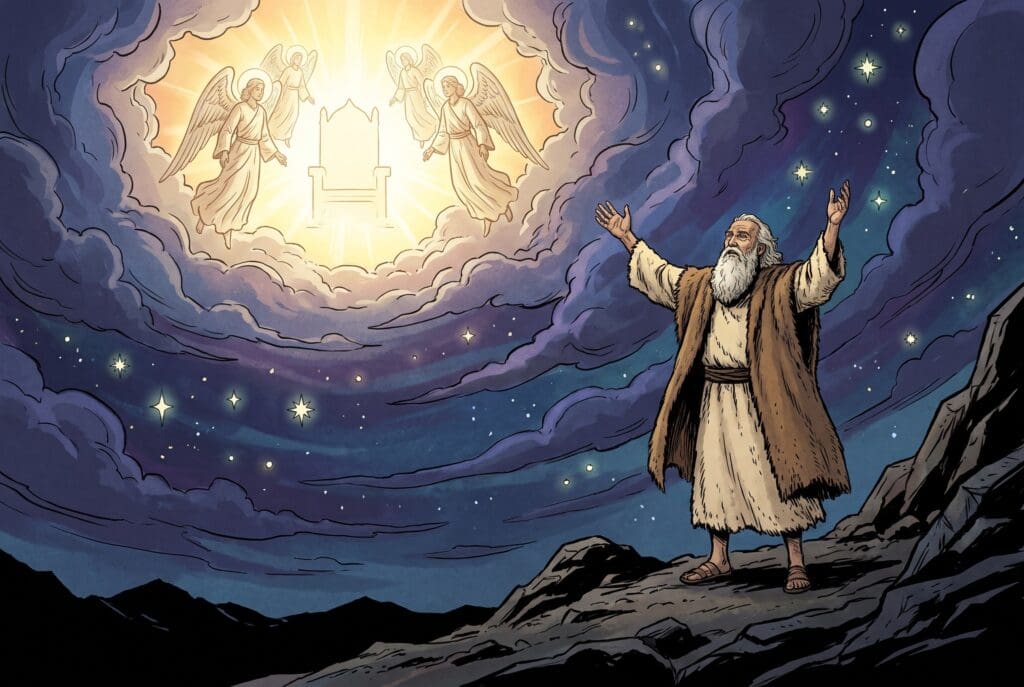
The Book of Enoch is attributed to Enoch, the patriarch described in Genesis 5:21-24 as a man who "walked with God" and was taken up rather than dying a natural death. Written centuries before the birth of Christ, the book presents itself as a record of visions Enoch received of heaven, the future, and the fate of the wicked. It opens with the strange and troubling story of the "Watchers," angels who left their proper place, took human wives, and taught humanity forbidden knowledge, corrupting the earth and leading God to judge it. Enoch also receives detailed visions of the heavens, the movements of the sun, moon, and stars, and a great heavenly throne room where final judgment is pronounced on both angels and men. Later sections describe a coming figure called the "Son of Man" who will judge the nations and vindicate the righteous, along with a sweeping vision of history retold through the symbolic image of animals. The book closes with Enoch's exhortations to his children and to future generations to hold fast to righteousness while they wait for God's judgment to come. It is not part of the Bible recognized by most Christian traditions, but it is included in the Old Testament canon of the Ethiopian Orthodox Tewahedo Church, and this site includes it as part of that fuller canon.
For Teachers & Pastors: A Closer Look
1 Enoch (also called the Ethiopic Enoch, to distinguish it from later Enoch texts) is a composite work made up of five originally separate sections likely written by different hands over several centuries: the Book of the Watchers (chapters 1-36), the Book of Parables or Similitudes (37-71), the Astronomical Book (72-82), the Book of Dream Visions (83-90, including the well-known 'Animal Apocalypse'), and the Epistle of Enoch (91-108). It is not part of the Hebrew Bible, the Jewish canon, or the Protestant or Catholic Old Testament, but it is accepted as fully canonical scripture by the Ethiopian Orthodox Tewahedo Church and the Eritrean Orthodox Tewahedo Church, the only faith communities to have preserved the complete text across the centuries, in Ge'ez. Western scholars only gained access to a complete copy after the Scottish traveler James Bruce brought Ethiopic manuscripts back to Europe in the 1770s. The discovery of Aramaic fragments of the book among the Dead Sea Scrolls at Qumran, beginning in 1947, confirmed that most of the work (all sections except the Parables) dates to the 3rd-2nd century BC, making it older than nearly every book of the New Testament. The Book of Parables, missing from the Qumran fragments, is generally dated somewhat later, to the 1st century BC or 1st century AD, and its portrait of a heavenly 'Son of Man' figure has drawn significant scholarly interest for its possible relationship to New Testament Christology. The book was influential in Second Temple Judaism and is directly quoted as prophecy in the New Testament epistle of Jude (Jude 1:14-15, quoting 1 Enoch 1:9), and its account of the Watchers stands behind other New Testament references to angels who sinned and are held for judgment (2 Peter 2:4, Jude 1:6). R.H. Charles's 1917 translation, used as the source text here, remains one of the most widely used English editions of the complete work.
