Daniel
Themes
Faithfulness to God under pressure to compromise, God's absolute sovereignty over human kings and empires, deliverance from life-threatening danger (the fiery furnace, the lions' den), and prophetic visions of future kingdoms culminating in God's everlasting kingdom.
Original Language
Hebrew and Aramaic
Introduction
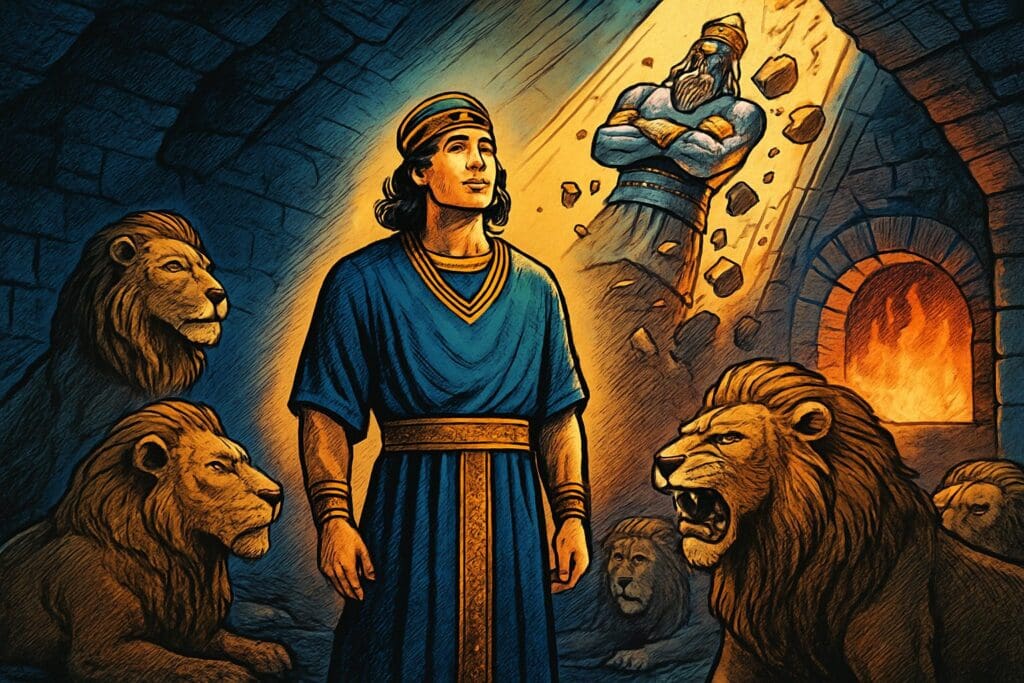
Daniel tells the story of a young Jewish man taken captive to Babylon as a teenager, who rises to become a trusted advisor to a series of powerful, often unpredictable kings, all while refusing to compromise his faith. The first half of the book (chapters 1-6) is made up of well-known stories: Daniel and his friends refusing the king's food, three friends surviving a fiery furnace, a mysterious hand writing on a wall, and Daniel himself surviving a night in a den of lions, each one showing that God protects and honors those who stay faithful to Him even when it's costly.
The second half of the book (chapters 7-12) shifts to Daniel's own visions of future kingdoms and world events, told in vivid, sometimes strange imagery: beasts rising from the sea, a ram and a goat locked in battle, and detailed prophecies about kingdoms that would rise and fall. Through it all, the book's central message stays the same: human empires come and go under God's control, but His kingdom will never end.
For Teachers & Pastors: A Closer Look
Daniel is set during the Babylonian exile, beginning with Daniel's deportation to Babylon around 605 BC under Nebuchadnezzar and extending into the Persian period under Cyrus, spanning roughly seventy years of Daniel's life and the transition between two major world empires. The book is notably bilingual: chapters 1 and 8-12 are written in Hebrew, while chapters 2-7 are written in Aramaic, the administrative language of the Babylonian and Persian empires, a structure that roughly tracks the book's shift from narrative material relevant to the wider empire toward visions specifically concerning Israel's future.
The book is often divided into two genres: court narratives (chapters 1-6), which read as stories of faithful living in a pagan court, and apocalyptic visions (chapters 7-12), which use symbolic imagery of beasts and kingdoms to describe the rise and fall of empires and point toward a final, everlasting kingdom established by God. Daniel's vision of "one like a son of man" receiving an everlasting dominion (chapter 7) became one of the most theologically significant messianic images in later Jewish and Christian thought, and the book as a whole had major influence on later apocalyptic literature, including parts of the New Testament book of Revelation.
