Baruch
Themes
Exile and repentance, the confession of Israel's sin, the enduring value of divine wisdom found in the Law, and hope for Jerusalem's promised restoration and the return of God's scattered people.
Original Language
Baruch was composed in Greek, though many scholars believe parts of it, especially the opening prayer and confession, may reflect an earlier Hebrew or Aramaic original that has not survived. It is grouped among the Catholic Deuterocanonical books.
Introduction
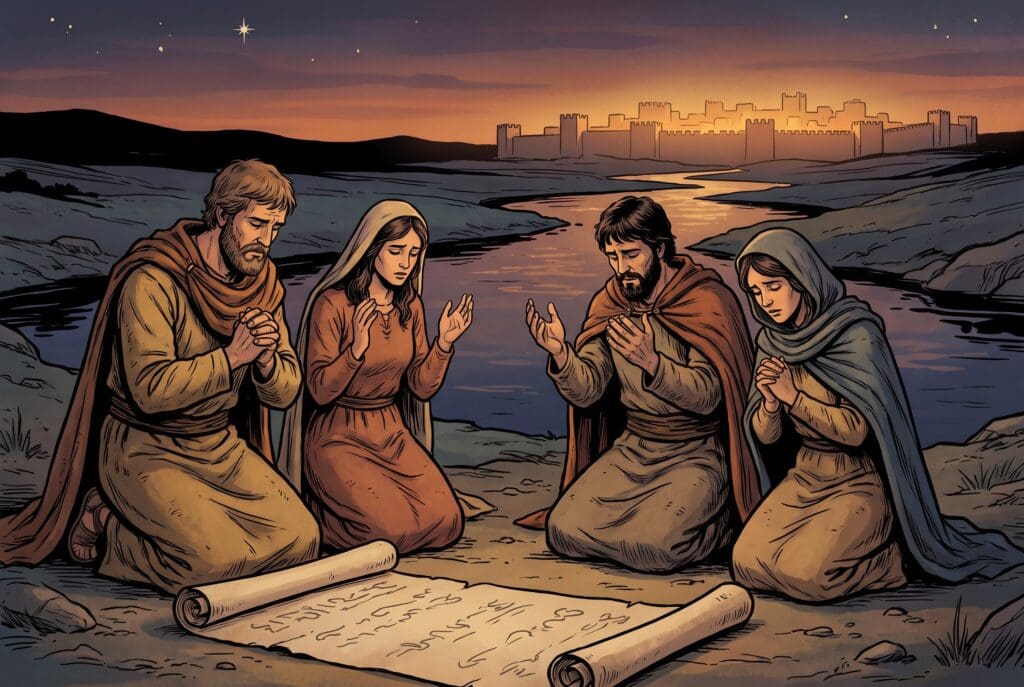
The Book of Baruch is presented as the words of Baruch, the trusted scribe and companion of the prophet Jeremiah, written to the Jewish exiles in Babylon. The book opens with the exiles gathered in sorrow, confessing that their nation's suffering came from turning away from God's law. This confession leads into a heartfelt prayer asking for mercy and a promise that Israel will one day return home. At its center, Baruch turns to a beautiful poem in praise of wisdom, declaring that true wisdom is not some far-off mystery but is found close at hand, in the law God has already given his people. The book closes with an oracle of comfort, picturing Jerusalem clothed in mourning being told to take off her sorrow and put on the beauty of God's glory, as her scattered children are gathered home again. From beginning to end, Baruch moves from honest confession to steady hope, reminding its readers that even after failure, God's mercy and wisdom remain within reach.
For Teachers & Pastors: A Closer Look
Baruch is a composite work, likely assembled from several originally separate pieces: an opening prose confession and prayer (1:1-3:8), a wisdom poem often compared to Sirach 24 and Job 28 (3:9-4:4), and a closing poetic oracle of consolation for Jerusalem (4:5-5:9) that shares notable parallels with portions of Isaiah 40-66 and the Psalms of Solomon. Its traditional attribution to Jeremiah's scribe places its narrative setting in the early Babylonian exile, though most modern scholars date its actual composition considerably later, likely in the Hellenistic or early Hasmonean period, with some proposing dates as late as the 2nd or 1st century BC. The book survives complete only in Greek and is part of the Septuagint; it is accepted as canonical Scripture by the Catholic Church and Eastern Orthodox churches but is treated as apocryphal by Protestant traditions. In many manuscripts and canonical lists, the Letter of Jeremiah, a separate polemic against idolatry, follows Baruch as a sixth chapter, though it is presented here as its own distinct work rather than appended to Baruch's five chapters.
