Amos
Themes
Social justice and God's demand for righteousness alongside worship, judgment on nations for cruelty and on Israel for exploiting the poor while maintaining empty religious ritual, and the danger of presuming on covenant privilege without covenant faithfulness.
Original Language
Hebrew
Introduction
Amos was a shepherd and fig farmer from Tekoa in Judah who was called by God to prophesy, unusually, against the northern kingdom of Israel during a time of prosperity and apparent stability under Jeroboam II. Beneath Israel's outward success, Amos saw deep corruption: the wealthy exploiting the poor, corrupt courts, dishonest business practices, and a religious system that kept up appearances while ignoring justice.
Amos opens with a series of oracles against surrounding nations for their brutality, oracles his Israelite audience likely cheered, before the pattern turns and lands squarely on Israel itself, showing that God holds His own covenant people to an even higher standard, not a lower one. Amos's famous declaration, 'let justice roll down like waters, and righteousness like an ever-flowing stream,' captures the book's central demand: worship without justice is empty. Yet the book closes with a genuine promise of future restoration, showing that God's judgment on His people was never meant to be His final word.
For Teachers & Pastors: A Closer Look
Amos prophesied during the reigns of Uzziah in Judah and Jeroboam II in Israel, roughly 760-750 BC, a period of significant political stability and economic prosperity for the northern kingdom, which had also allowed significant social inequality to flourish largely unchecked. Amos identifies himself not as a professional prophet but as a herdsman and tender of sycamore figs (7:14-15), called directly by God despite lacking formal prophetic training or lineage, a detail that becomes central to his confrontation with Amaziah, the priest of the royal sanctuary at Bethel, who tries to expel him (7:10-17).
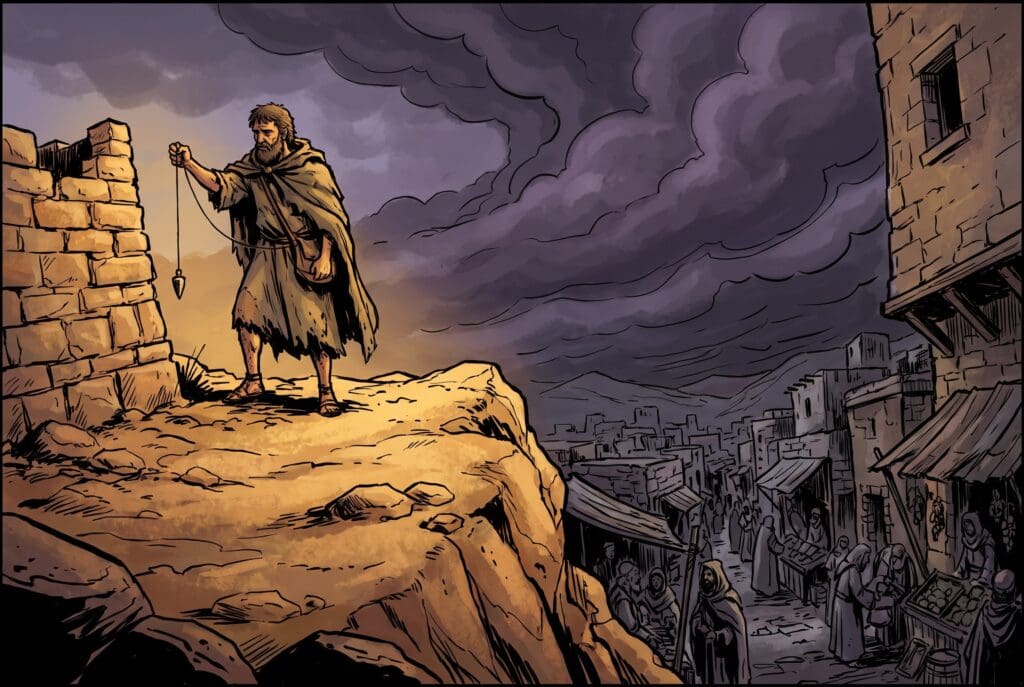
The book's structure moves from oracles against foreign nations (Damascus, Gaza, Tyre, Edom, Ammon, Moab, chapters 1-2) in an escalating pattern ('for three transgressions... and for four') that surprisingly turns to include Judah and then lands with full force on Israel itself, followed by extended indictments of Israel's specific social sins, including exploitation of the poor, corrupt courts, and religious ritual divorced from justice (chapters 3-6). The book includes five visions of judgment (locusts, fire, a plumb line, a basket of summer fruit, and the LORD standing by the altar, chapters 7-9) before closing with a promise to restore the 'fallen tabernacle of David' (9:11-15), a passage James quotes at the Jerusalem Council in Acts 15:16-17 regarding the inclusion of Gentiles in God's people.
