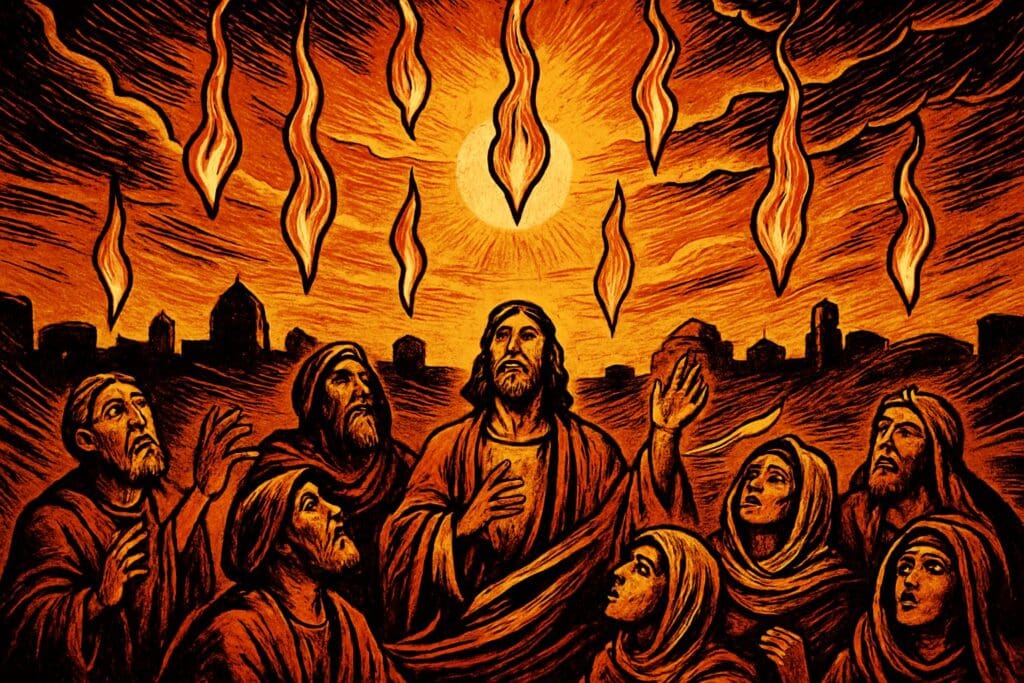
Acts
Themes
The birth and rapid growth of the early church, the coming of the Holy Spirit at Pentecost, the boldness of the apostles under persecution, the spread of the gospel from Jerusalem to Rome, the inclusion of the Gentiles, and the transformative power of the gospel in individual lives (most notably the conversion of Saul/Paul).
Original Language
Koine Greek
Introduction
The book of Acts (sometimes called the Acts of the Apostles) picks up right where the Gospel of Luke leaves off, written by the same author, a doctor named Luke who traveled with the apostle Paul. It tells the story of what happened after Jesus rose from the dead and returned to heaven.
At the very start of Acts, Jesus promises His followers that they will receive power when the Holy Spirit comes upon them, and that they will be His witnesses starting in Jerusalem and eventually reaching the ends of the earth. That is exactly what happens over the course of this book. The Holy Spirit arrives dramatically on the day of Pentecost, and a small, frightened group of disciples suddenly becomes a bold, unstoppable movement.
Acts follows the apostles, especially Peter early on and then Paul for most of the book, as they preach, heal the sick, plant churches, and face intense opposition and persecution. One of the most dramatic moments is the conversion of Saul, a fierce persecutor of Christians, who is blinded by a vision of Jesus on the road to Damascus and becomes Paul, the most influential missionary in the early church.
By the end of Acts, the gospel has spread from a small group praying in an upper room in Jerusalem all the way to Rome, the capital of the ancient world, showing that the good news of Jesus was never meant to stay in one place.
For Teachers & Pastors: A Closer Look
Acts serves as the second volume of Luke's two-part work (Luke-Acts), sharing common themes, vocabulary, and a shared dedication to Theophilus. It functions as both a historical narrative and a theological argument for the legitimacy of the Gentile mission and the church's continuity with Israel's story.
Structurally, many scholars note that Acts 1:8 ("you will be my witnesses in Jerusalem and in all Judea and Samaria, and to the end of the earth") functions as a geographic and thematic outline for the entire book: Jerusalem (chs. 1-7), Judea and Samaria (chs. 8-12), and the ends of the earth (chs. 13-28), tracking Paul's missionary journeys into the wider Greco-Roman world.
Acts also documents the Jerusalem Council (Acts 15), a pivotal moment addressing whether Gentile converts needed to observe the Mosaic law, a foundational moment for defining the identity and boundaries of the early church distinct from Second Temple Judaism.
The book ends somewhat abruptly with Paul under house arrest in Rome, still preaching, which has led to significant scholarly discussion about Luke's purpose and possible date of composition, with proposals ranging from the early 60s AD to later in the first century.
