2 Maccabees
Themes
Faithful endurance under persecution, including the willingness to die rather than violate God's law; God's temple and people under his personal, watchful protection; the consequences of national sin and the mercy of national repentance; martyrdom as a witness to resurrection hope; and the value of honoring and praying for the faithful departed.
Original Language
Greek
Introduction
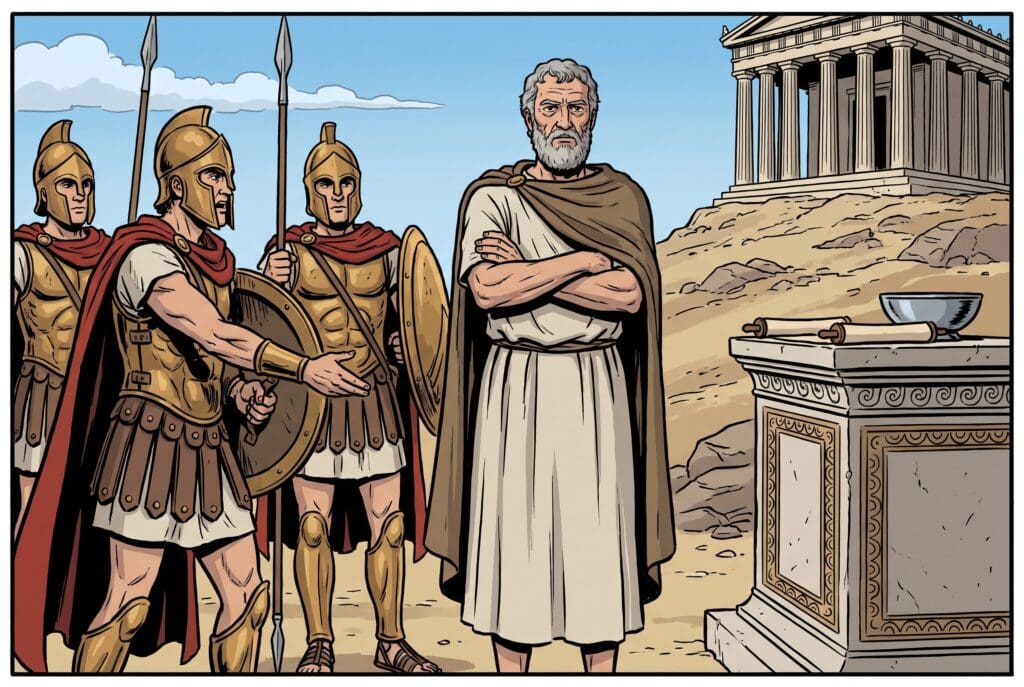
2 Maccabees retells the same historical period as 1 Maccabees, the persecution under Antiochus IV Epiphanes and the early Maccabean revolt, but with a more overtly theological, sermon-like style and a narrower focus on roughly the first fifteen years of the conflict. The book opens with two letters urging Egyptian Jews to celebrate the temple's rededication, then narrates the crisis in Jerusalem, including vivid, moving accounts of martyrdom, most famously the elderly scribe Eleazar and a mother and her seven sons, who choose torture and death rather than violate God's law.
The book presents these sufferings as having a redemptive purpose, understood as purifying discipline for a sinful nation rather than meaningless tragedy, and celebrates Judas Maccabeus's subsequent military victories as God's mercy returning to his people. It closes with the death of the persecutor Nicanor and a notable passage describing Judas praying and offering sacrifice for fallen soldiers, hoping for their resurrection, a passage that has shaped later Christian reflection on prayer for the dead.
For Teachers & Pastors: A Closer Look
2 Maccabees (composed in Greek, likely in the 2nd-1st century BC, explicitly presented as a condensed abridgment of a longer five-volume work by a certain Jason of Cyrene, and accepted as canonical Scripture by the Catholic Church and Eastern Orthodox Church) covers a narrower period than 1 Maccabees (roughly 175-161 BC, ending with Nicanor's death rather than continuing through Simon's reign) but treats it with a distinctly different literary approach: more overtly theological, rhetorically elaborate, and structured around dramatic set-piece scenes (the martyrdoms of ch. 6-7, Heliodorus's failed temple robbery in ch. 3) rather than 1 Maccabees's sober annalistic style.
The book is theologically significant for several developments not as explicit in 1 Maccabees, including a clear affirmation of bodily resurrection voiced by the martyred sons in chapter 7, a doctrine of creation ex nihilo (7:28), and the passage in chapter 12 describing Judas's sin offering and prayers on behalf of fallen soldiers, historically influential in later Jewish and Christian practices of prayer for the dead. Scholars generally regard 1 and 2 Maccabees as independent, sometimes divergent historical sources covering overlapping events, useful for cross-checking rather than a single continuous narrative.
