1 Maccabees
Themes
Faithful resistance to forced cultural and religious assimilation; courageous, costly leadership passed from father to sons across a sustained multi-generational struggle; the rededication of the temple as a picture of restored worship after desecration; and the tension between political pragmatism (alliances with Rome and others) and steadfast religious conviction in securing a people's survival and independence.
Original Language
Hebrew (surviving fully only in Greek)
Introduction
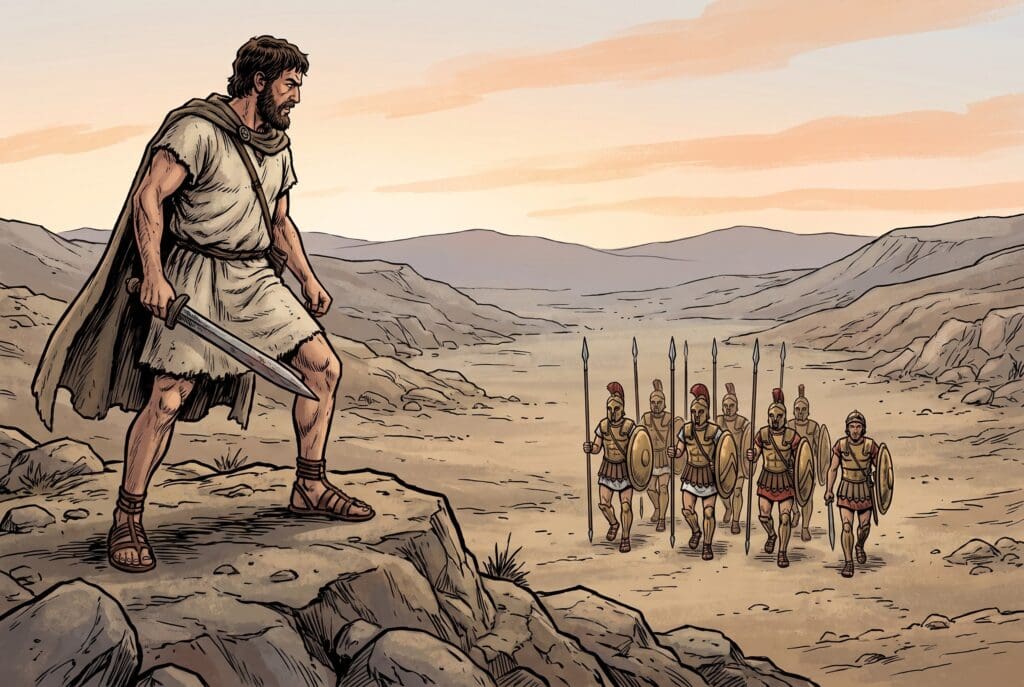
1 Maccabees tells the sober, historically grounded story of the Jewish revolt against the Seleucid Greek king Antiochus IV Epiphanes, who outlawed Jewish religious practice and desecrated the Jerusalem temple by installing a pagan altar to Zeus. When Antiochus's officers try to force the elderly priest Mattathias to offer a pagan sacrifice, he refuses, kills the officer, and flees to the hills with his five sons, launching an armed resistance movement.
Mattathias's son Judas, nicknamed Maccabeus ('the hammer'), leads a series of remarkable military victories against much larger Seleucid forces, eventually recapturing and rededicating the temple, an event still celebrated today as Hanukkah. The book follows the ongoing struggle across roughly forty years and multiple leaders, Judas, then his brothers Jonathan and Simon, as the Jewish people fight for religious freedom and eventually establish an independent Hasmonean kingdom.
For Teachers & Pastors: A Closer Look
1 Maccabees (likely composed around 100 BC in Hebrew, though it survives fully only in Greek, and accepted as canonical Scripture by the Catholic Church and Eastern Orthodox Church) is widely regarded by historians as one of the most reliable and historically valuable narrative sources in the deuterocanonical corpus, written in a sober, annalistic style closely modeled on the Hebrew historical books (Samuel, Kings) rather than the more legendary or folk-tale style found in books like Tobit or Judith.
The book covers roughly 175-134 BC, from Antiochus IV's accession through the death of Simon Maccabeus, and provides crucial historical background for the intertestamental period, including the origin of Hanukkah (the temple's rededication in ch. 4) and the establishment of the Hasmonean dynasty that governed Judea until the Roman period. Notably, the book largely avoids explicit references to God acting directly (preferring language like 'heaven' or describing Judas's own faith and prayers rather than narrating direct divine intervention), a stylistic restraint that has led some scholars to see it as reflecting a specifically Hasmonean political perspective, written to legitimize and celebrate the new ruling dynasty's founding generation.
