1 Esdras
Themes
Temple restoration, faithful worship, the authority of Scripture publicly read and obeyed, and the conviction that truth is the strongest force in the world.
Original Language
1 Esdras survives complete in Greek and is part of the Septuagint. Much of its content closely parallels the Hebrew/Aramaic text of 2 Chronicles, Ezra, and Nehemiah, leading most scholars to see it either as an alternate Greek translation of that same underlying material or a free retelling compiled from it, with one substantial original addition: the "Debate of the Three Guardsmen" (chapters 3-4), which has no parallel in the Hebrew Bible at all.
Introduction
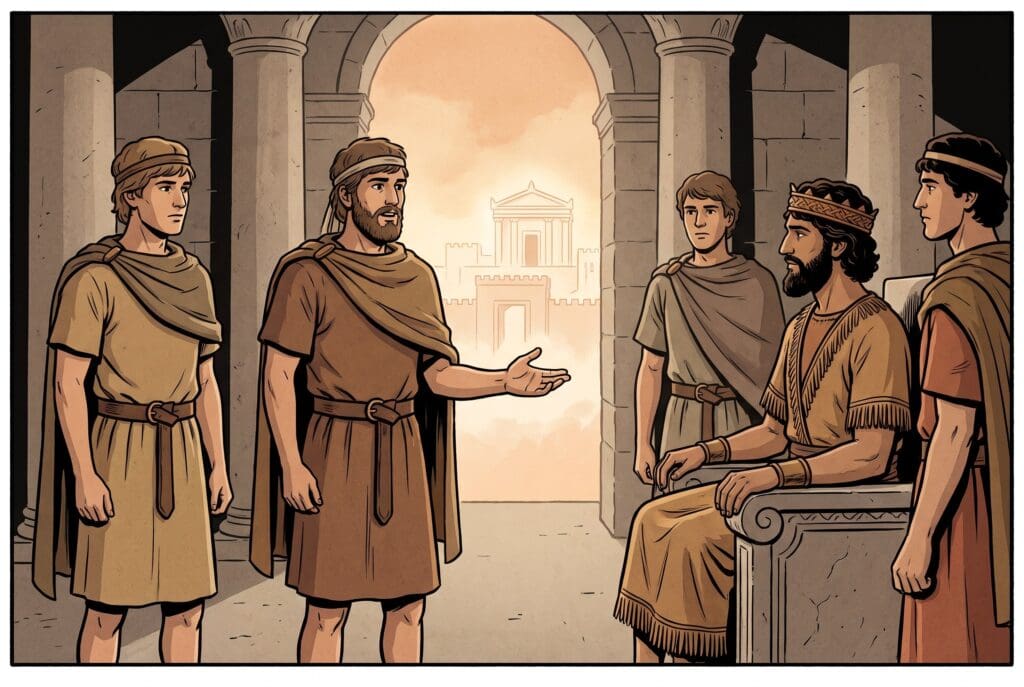
1 Esdras retells the story of the end of the kingdom of Judah, the exile in Babylon, and the return and rebuilding of the Temple in Jerusalem, covering much of the same ground as the closing chapters of 2 Chronicles and the books of Ezra and Nehemiah. It opens with King Josiah's great Passover celebration, moves through the fall of Jerusalem and the Babylonian exile, and follows the decree of King Cyrus that allowed the exiles to return home. At its heart is a story found nowhere else in Scripture: three young guardsmen serving in the Persian king's court debate what is the strongest thing in the world, wine, the king, or women, until one of them, Zerubbabel, wins the contest by arguing that truth is strongest of all. His prize is the king's support for rebuilding Jerusalem and its Temple. The book closes with Ezra's public reading of the Law to the returned community, a moment of renewed commitment to God's word after years of exile and loss.
For Teachers & Pastors: A Closer Look
1 Esdras (also called 3 Esdras in some Latin Vulgate numbering systems) is preserved in Greek as part of the Septuagint and closely parallels 2 Chronicles 35-36, the whole book of Ezra, and Nehemiah 8, generally following the same narrative order with some differences in sequence and detail. Its most distinctive contribution is the 'Debate of the Three Guardsmen' or 'Tale of the Three Youths' (3:1-5:6), a court-contest narrative with no parallel in the Hebrew canon, in which Zerubbabel's winning speech on the strength of truth serves as the narrative hinge that secures royal support for the Temple's reconstruction. Scholars are divided on whether 1 Esdras represents an independent, possibly earlier Greek translation tradition than the one underlying the Septuagint's Ezra-Nehemiah, or a later free compilation drawing on those books. It is accepted as canonical by the Eastern Orthodox Church and included in an appendix in the Latin Vulgate, but is not part of the Catholic canon proper and is treated as apocryphal in Protestant tradition. Josephus relied heavily on 1 Esdras rather than the Hebrew Ezra-Nehemiah for his own retelling of this period in the Antiquities of the Jews.
