Author: Answers In Bible

  • What Is Divination in the Bible?

    What Is Divination in the Bible?

    Divination is the practice of trying to predict the future or uncover hidden knowledge through occult means, and the Bible consistently and clearly forbids it. From fortune-telling to omens to consulting the dead, scripture treats these practices as a serious departure from trusting God alone. Here is what the Bible actually says.

    What Is Divination in the Bible?

    Divination covers a range of practices aimed at learning secret or future information through means other than God, things like reading omens, casting spells, consulting spirits, or interpreting signs to predict outcomes. The ancient world Israel lived in was full of these practices, from Egyptian magicians to Babylonian astrologers. Scripture draws a sharp line between seeking guidance from God, through prayer, prophets, and His revealed word, and seeking it through divination.

    Why the Law Forbids It

    Deuteronomy 18 lists divination among a group of practices explicitly forbidden to Israel: “There shall not be found among you any one that maketh his son or his daughter to pass through the fire, or that useth divination, or an observer of times, or an enchanter, or a witch, or a charmer, or a consulter with familiar spirits, or a wizard, or a necromancer” (Deuteronomy 18:10-11). The reason given is direct: “For all that do these things are an abomination unto the LORD” (Deuteronomy 18:12). Leviticus 19:26 adds a similar prohibition: “Ye shall not eat any thing with the blood: neither shall ye use enchantment, nor observe times.” Rather than leaving Israel to guess at the future through omens, God set apart prophets to reveal what the nation needed to know.

    Divination in the New Testament

    The New Testament shows the same practice still active in the first century. In Acts 16, Paul and his companions encounter “a certain damsel possessed with a spirit of divination” who made money for her owners through soothsaying (Acts 16:16). Paul does not negotiate with the spirit or try to use its predictive power for good. He commands it out of her in the name of Jesus Christ, and it leaves immediately (Acts 16:18). The episode reinforces the same Old Testament principle in a New Testament setting: divination is treated as a spiritual problem to be confronted, not a neutral tool to make use of.

    Key Bible Verses

    Deuteronomy 18:10-11
    “There shall not be found among you any one that maketh his son or his daughter to pass through the fire, or that useth divination, or an observer of times, or an enchanter, or a witch, or a charmer, or a consulter with familiar spirits, or a wizard, or a necromancer.”

    Deuteronomy 18:12
    “For all that do these things are an abomination unto the LORD.”

    Acts 16:16
    “And it came to pass, as we went to prayer, a certain damsel possessed with a spirit of divination met us, which brought her masters much gain by soothsaying.”

    Frequently Asked Questions

    Is astrology the same thing as divination in the Bible?

    Astrology, using the position of stars to predict the future or guide decisions, falls under the same category of forbidden practices, since it seeks hidden knowledge apart from God rather than through Him. Isaiah 47:13-14 specifically mocks Babylon’s astrologers for being unable to save themselves.

    Why does the Bible take divination so seriously?

    At its core, divination represents an attempt to gain control or certainty apart from trusting God, and scripture consistently treats that pursuit as spiritually dangerous rather than harmless curiosity. The consistent alternative offered throughout scripture is prayer and trust in God’s revealed word.

    Related Bible Topics

    What Does “Abomination” Mean in the Bible? | Does the Bible Say Not to Question God? | What Are the Fruits of the Spirit?

    Ask a Deeper Question

    Have a specific question about divination or a related passage? Ask below and get an instant, scripture-based answer.

  • Faithful and Just to Forgive | 1 John 1:9

    Faithful and Just to Forgive | 1 John 1:9

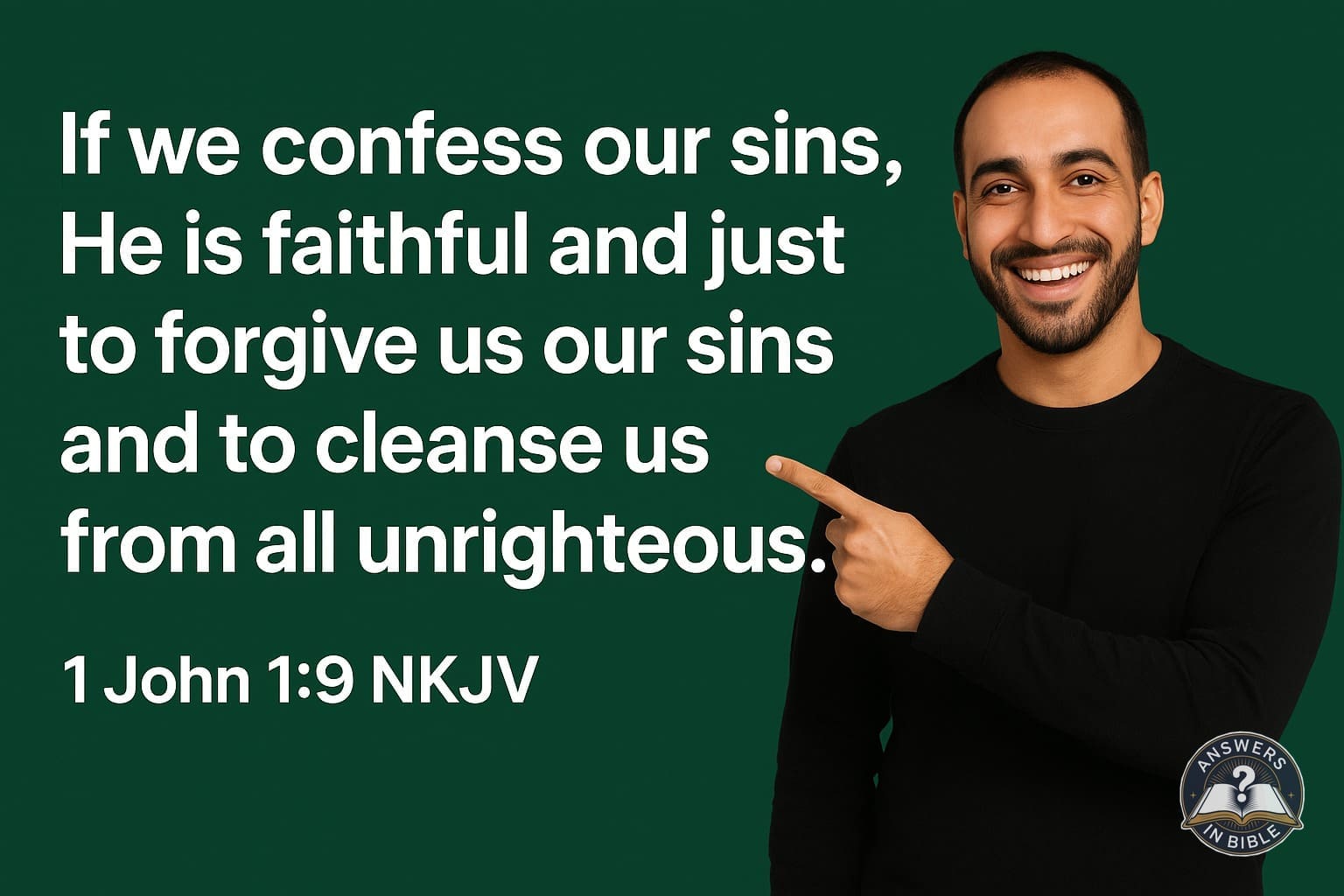
    “If we confess our sins, He is faithful and just to forgive us our sins and to cleanse us from all unrighteousness” (1 John 1:9, NKJV). Faithful and just describes God’s response to confession, not reluctant or grudging, but reliably true to His own character.

    All unrighteousness rules out partial cleansing. This isn’t a promise to address some sins while leaving others unresolved.

    The condition is simple: confess. Not elaborate penance or extended self-punishment, just honest naming of what’s actually there.

    What sin have you been carrying without actually confessing it honestly, that this verse promises complete forgiveness and cleansing for?

  • What Does Spiritual Warfare Mean in the Bible?

    What Does Spiritual Warfare Mean in the Bible?

    “Spiritual warfare” refers to the Bible’s picture of the Christian life as an ongoing conflict against evil that is not fought with physical weapons. The phrase itself is not in most English Bibles, but the concept runs throughout scripture, most clearly in Paul’s letter to the Ephesians. Here is what it means and how the Bible describes fighting it.

    What Does Spiritual Warfare Mean in the Bible?

    Paul lays out the idea most directly in Ephesians 6:12: “For we wrestle not against flesh and blood, but against principalities, against powers, against the rulers of the darkness of this world, against spiritual wickedness in high places.” The point is not that people are the real enemy. It is that behind human conflict, temptation, and evil, scripture describes a deeper spiritual opposition that Christians are called to resist, not with violence or manipulation, but with the resources God provides.

    The Whole Armor of God

    Right before naming the real enemy, Paul gives the main instruction for this kind of fight: “Put on the whole armour of God, that ye may be able to stand against the wiles of the devil” (Ephesians 6:11). He then lists specific pieces, truth, righteousness, the gospel of peace, faith, salvation, and the word of God, each pictured as armor a Roman soldier would have worn. The emphasis throughout is on standing firm and being prepared, not on aggression. Spiritual warfare in Paul’s picture looks more like defense and endurance than attack.

    Not Carnal, But Mighty Through God

    Paul makes a similar point to the Corinthians: “For the weapons of our warfare are not carnal, but mighty through God to the pulling down of strong holds” (2 Corinthians 10:4). The weapons in view throughout the New Testament are things like prayer, scripture, faith, and the truth of the gospel, not political power or force. This is a consistent thread in how the Bible describes resisting evil: real conflict, taken seriously, but fought on spiritual terms.

    Key Bible Verses

    Ephesians 6:11
    “Put on the whole armour of God, that ye may be able to stand against the wiles of the devil.”

    Ephesians 6:12
    “For we wrestle not against flesh and blood, but against principalities, against powers, against the rulers of the darkness of this world, against spiritual wickedness in high places.”

    2 Corinthians 10:4
    “For the weapons of our warfare are not carnal, but mighty through God to the pulling down of strong holds.”

    Frequently Asked Questions

    Does spiritual warfare mean fighting against other people?

    No. Ephesians 6:12 specifically says the struggle is “not against flesh and blood.” The Bible’s picture of spiritual warfare directs attention away from treating other people as the enemy and toward prayer, scripture, and character as the real battleground.

    What is the most common piece of spiritual armor mentioned in Ephesians 6?

    Each piece gets its own verse (Ephesians 6:14-17), but Paul closes the list by tying prayer to the whole picture in verse 18, describing it as praying “always with all prayer and supplication in the Spirit.” Many readers treat prayer as the piece that activates and sustains the rest.

    Related Bible Topics

    What Does the Bible Say About Fear? | Common Questions About the Holy Spirit | What Is “The Flesh” in the Bible?

    Ask a Deeper Question

    Have a specific question about spiritual warfare or a related passage? Ask below and get an instant, scripture-based answer.

  • Looking Unto Jesus | Hebrews 12:1-2

    Looking Unto Jesus | Hebrews 12:1-2

    “Let us run with endurance the race that is set before us, looking unto Jesus, the author and finisher of our faith” (Hebrews 12:1-2, NKJV). Endurance, not speed, is the quality named here. This race isn’t won by a fast start, but by consistent, sustained running.

    Looking unto Jesus is the key to that endurance. Not staring at the difficulty of the race itself, but keeping eyes fixed on the One who authored and will finish the faith being run.

    That’s worth remembering when the race feels long and the finish line isn’t visible. The instruction isn’t to see the whole course clearly, it’s to keep looking at Jesus.

    What would it look like today to run your current race with endurance, eyes fixed on Jesus rather than fixated on how far there still is to go?

  • Who Are the Gentiles in the Bible?

    Who Are the Gentiles in the Bible?

    “Gentiles” is the Bible’s term for anyone who is not Jewish, and understanding the word unlocks one of the biggest turning points in the whole biblical story. From the Old Testament’s focus on Israel to the New Testament’s message going out to “every nation,” the story of the Gentiles is really the story of who gets included in God’s promises.

    Who Are the Gentiles?

    In scripture, “Gentiles” (from a Hebrew and Greek root meaning “nations” or “peoples”) refers to anyone outside the physical descendants of Israel. In the Old Testament, Israel was set apart with its own covenant, law, and calling, while the Gentile nations around it worshiped other gods. That distinction shaped centuries of Jewish identity and religious practice, and it is the backdrop for nearly everything that changes in the New Testament.

    Once Far Off, Now Brought Near

    Paul describes the Gentiles’ former standing bluntly in Ephesians 2:12: “That at that time ye were without Christ, being aliens from the commonwealth of Israel, and strangers from the covenants of promise, having no hope, and without God in the world.” But he immediately follows it with the change Christ brought: “But now in Christ Jesus ye who sometimes were far off are made nigh by the blood of Christ” (Ephesians 2:13). This is the heart of the Gentile story in the New Testament: people who had no covenant standing with God are brought into one.

    The Gospel Opens to “Every Nation”

    This shift is not a quiet footnote. Paul states the gospel’s reach plainly in Romans 1:16: “For I am not ashamed of the gospel of Christ: for it is the power of God unto salvation to every one that believeth; to the Jew first, and also to the Greek.” The book of Acts records the moment this became undeniable to the early Jewish church, when Peter, after a vision and an encounter with a Roman centurion named Cornelius, declared, “Of a truth I perceive that God is no respecter of persons: But in every nation he that feareth him, and worketh righteousness, is accepted with him” (Acts 10:34-35). From that point forward, the church understood its mission as reaching Gentiles and Jews alike, not one group at the exclusion of the other.

    Key Bible Verses

    Ephesians 2:13
    “But now in Christ Jesus ye who sometimes were far off are made nigh by the blood of Christ.”

    Romans 1:16
    “For I am not ashamed of the gospel of Christ: for it is the power of God unto salvation to every one that believeth; to the Jew first, and also to the Greek.”

    Acts 10:34-35
    “Then Peter opened his mouth, and said, Of a truth I perceive that God is no respecter of persons: But in every nation he that feareth him, and worketh righteousness, is accepted with him.”

    Frequently Asked Questions

    Is “Gentile” used as an insult in the Bible?

    No, it is simply a descriptive term for non-Jewish peoples, though attitudes between Jews and Gentiles were often tense historically. The New Testament’s overall direction is toward removing that division in Christ rather than reinforcing it (Galatians 3:28).

    Does the Old Testament ever include Gentiles in God’s plan?

    Yes. Even though Israel had a unique covenant role, the Old Testament includes Gentile individuals like Ruth and Rahab within God’s story, and passages like Genesis 12:3 promise that all nations, not Israel alone, would ultimately be blessed through Abraham’s line.

    Related Bible Topics

    How Can I Be Saved According to the Bible? | What Is the New Covenant in the Bible? | What Is the Greatest Commandment in the Bible?

    Ask a Deeper Question

    Have a specific question about the Gentiles or a related passage? Ask below and get an instant, scripture-based answer.

  • Esteem Others Better Than Himself | Philippians 2:3

    Esteem Others Better Than Himself | Philippians 2:3

    “Let nothing be done through selfish ambition… but in lowliness of mind let each esteem others better than himself” (Philippians 2:3, NKJV). Selfish ambition rarely announces itself directly. It usually disguises itself as legitimate drive or vision.

    The alternative offered here is demanding: esteeming others as better than yourself, not false modesty, but genuine regard placed above self-promotion.

    This is hard to practice consistently, especially in competitive environments that reward self-promotion over humility.

    Where has selfish ambition been quietly shaping a recent decision, in a way this verse calls you to replace with genuine esteem for someone else instead?

  • Why Is the Resurrection Important?

    Why Is the Resurrection Important?

    The resurrection of Jesus Christ is the one event the entire Christian faith is built on, not just a comforting ending to the Easter story. Without it, the New Testament writers themselves say there would be nothing left to believe. Here is why the resurrection matters so much, and what it actually changes.

    What Does the Resurrection Mean?

    The resurrection refers to Jesus rising bodily from the dead on the third day after His crucifixion, an event all four Gospels describe and the rest of the New Testament treats as historical fact, not symbol. It is different from Jesus simply surviving death or living on in memory. The claim is specific: He was truly dead, buried, and then truly alive again, appearing to His disciples and, according to Paul, to more than five hundred people at once (1 Corinthians 15:6).

    Why Paul Said Everything Depends on It

    The apostle Paul makes the stakes unusually clear in 1 Corinthians 15. He does not treat the resurrection as one important belief among many. He says that if it did not happen, Christian preaching and faith are both empty: “And if Christ be not risen, then is our preaching vain, and your faith is also vain” (1 Corinthians 15:14). A few verses later he states the positive case just as directly: “But now is Christ risen from the dead, and become the firstfruits of them that slept” (1 Corinthians 15:20). In Paul’s argument, the resurrection is not decoration on top of the gospel. It is the proof that the rest of it is true.

    What the Resurrection Changes for Believers Today

    The resurrection is not only a past event to affirm. Romans 6:4 ties it directly to how believers are meant to live now: “Therefore we are buried with him by baptism into death: that like as Christ was raised up from the dead by the glory of the Father, even so we also should walk in newness of life.” And Romans 10:9 ties it to how a person is saved in the first place: “That if thou shalt confess with thy mouth the Lord Jesus, and shalt believe in thine heart that God hath raised him from the dead, thou shalt be saved.” Belief in a risen, living Jesus, not merely a good teacher who once lived, is at the center of Christian faith. It is also the basis for the hope that death does not have the final word for believers either.

    Key Bible Verses

    1 Corinthians 15:14
    “And if Christ be not risen, then is our preaching vain, and your faith is also vain.”

    1 Corinthians 15:20
    “But now is Christ risen from the dead, and become the firstfruits of them that slept.”

    Romans 10:9
    “That if thou shalt confess with thy mouth the Lord Jesus, and shalt believe in thine heart that God hath raised him from the dead, thou shalt be saved.”

    Frequently Asked Questions

    Is the resurrection meant to be understood as a literal event?

    Yes. The Gospel writers and Paul present it as a real, physical event with named witnesses, not a metaphor for hope or renewal. Paul specifically argues that if it were not literally true, Christian faith would have no real foundation (1 Corinthians 15:17).

    How is Jesus’s resurrection different from others raised from the dead in the Bible?

    People like Lazarus (John 11) were raised back to ordinary mortal life and eventually died again. The New Testament presents Jesus’s resurrection as different in kind: a permanent, glorified resurrection to a life no longer subject to death, described as the “firstfruits” of what is promised to believers as well.

    Related Bible Topics

    How Can I Be Saved According to the Bible? | Where Did Jesus Go When He Died? What the Bible Says About Hades | What Is the Book of Life in the Bible?

    Ask a Deeper Question

    Have a specific question about the resurrection or a related passage? Ask below and get an instant, scripture-based answer.

  • The Just Shall Live by His Faith | Habakkuk 2:4

    The Just Shall Live by His Faith | Habakkuk 2:4

    “The just shall live by his faith” (Habakkuk 2:4, NKJV). This short verse becomes foundational for much of the New Testament’s teaching on faith, quoted repeatedly by Paul and others.

    Live by his faith isn’t describing a single moment of belief, it’s describing an ongoing way of life, sustained day by day through faith rather than sight.

    This verse comes in the middle of Habakkuk’s own wrestling with God over injustice he can’t understand. The answer given isn’t a full explanation, it’s a call to keep living by faith regardless.

    What area of your life right now requires living by faith rather than waiting for full understanding before moving forward?

  • What Is the Greek Word for Sin?

    What Is the Greek Word for Sin?

    The New Testament was written in Greek, and the word it uses most often for “sin” carries a picture most modern readers miss entirely. That word is hamartia, and it comes from the world of archery: an arrow that flies wide and misses the target. Understanding this word, and a few related ones the Bible also uses, sheds real light on what Scripture means when it talks about sin.

    What Does “Hamartia” Mean?

    Hamartia (ἁμαρτία) is the primary Greek word translated “sin” throughout the New Testament. Long before it carried any religious meaning, it was an everyday word for missing a target, whether an arrow that fell short of the bullseye or a spear thrust that failed to land. When New Testament writers picked up this word, they were describing sin as falling short of a standard: specifically, God’s own perfect standard. Paul uses exactly this sense in Romans 3:23, saying that everyone has “sinned” and “come short of the glory of God.” Sin, in this picture, isn’t only about breaking a rule. It’s about aiming at a target, God’s righteousness, and missing it.

    Other Greek Words the Bible Uses for Sin

    Hamartia is the most common word, but it isn’t the only one. The New Testament uses several related Greek words, each highlighting a different angle on the same problem:

    Parabasis (παράβασις) means “transgression.” It comes from roots meaning “to step across,” the image of someone crossing a line that was clearly drawn. Paul uses this word in Romans 4:15 when he writes, “for where no law is, there is no transgression.” Parabasis describes sin as a specific, known boundary being crossed.

    Anomia (ἀνομία) means “lawlessness,” literally “without law.” Rather than one specific violation, it describes a whole posture of living outside God’s moral order. John uses this word in 1 John 3:4, defining sin itself in these terms: “sin is the transgression of the law” (rendered elsewhere as “sin is lawlessness”).

    Paraptoma (παράπτωμα) means “trespass” or “false step.” It pictures someone stumbling and losing their footing rather than deliberately crossing a line. Paul uses it in Ephesians 2:1, describing believers as once “dead in trespasses and sins” before God made them alive in Christ.

    Together, these words paint a fuller picture than any single English word can. Sin is missing the mark (hamartia), crossing a known line (parabasis), living outside God’s order (anomia), and losing one’s footing (paraptoma). Scripture is not vague about sin; it names the problem from several angles at once.

    Why the Word Study Matters

    Knowing that hamartia means “missing the mark” changes how a familiar verse reads. Romans 6:23 says, “For the wages of sin is death; but the gift of God is eternal life through Jesus Christ our Lord.” Sin, in the original language, isn’t just an isolated bad choice. It’s the ongoing condition of falling short of God’s glory, and Paul says plainly that this condition earns death as its wage. The same verse then turns to grace: eternal life isn’t earned the way sin’s wages are earned. It’s given as a gift. The Greek word study doesn’t change the meaning readers already know from English Bibles, but it does sharpen it, showing that sin is measured against God’s own standard of glory, not simply against a list of dos and don’ts.

    Key Bible Verses

    Romans 3:23
    “For all have sinned, and come short of the glory of God.”

    1 John 3:4
    “Whosoever committeth sin transgresseth also the law: for sin is the transgression of the law.”

    Romans 6:23
    “For the wages of sin is death; but the gift of God is eternal life through Jesus Christ our Lord.”

    Frequently Asked Questions

    Is hamartia the only Greek word for sin in the Bible?

    No. Hamartia is by far the most common, appearing hundreds of times in the New Testament, but Scripture also uses parabasis (transgression), anomia (lawlessness), and paraptoma (trespass) to describe sin from different angles. Each word adds detail to the same basic problem: humanity’s failure to meet God’s standard.

    Does “missing the mark” mean sin is just an accident?

    Not necessarily. The archery image describes the result, falling short of the target, without saying whether the miss was accidental or deliberate. Other Greek words used alongside hamartia, like parabasis and anomia, make clear that Scripture also treats sin as willful, a known line that gets crossed on purpose.

    Related Bible Topics

    What Does the Bible Say About Sin? | What Is Righteousness in the Bible? | What Does Faith Without Works Mean?

    Ask a Deeper Question

    Have a specific question about sin or a related passage? Ask below and get an instant, scripture-based answer.
  • No Purpose of Yours Can Be Withheld | Job 42:2

    No Purpose of Yours Can Be Withheld | Job 42:2

    “I know that You can do everything, And that no purpose of Yours can be withheld from You” (Job 42:2, NKJV). This confession comes after Job’s long, painful season of loss and questioning, not before it.

    That timing matters. This isn’t an easy, untested confidence in God’s sovereignty. It’s hard-won, arrived at after real suffering and real questions.

    No purpose of Yours can be withheld is a striking confidence, that whatever God intends will actually come to pass, regardless of what stands in the way.

    What purpose of God’s are you currently doubting will actually come to pass, that this hard-won confession invites you to trust anyway?