
Author: Answers In Bible

  • What Is the First Question in the Bible?

    What Is the First Question in the Bible?

    The first question in the Bible is asked in Genesis 3, and it comes from an unexpected source. Before God ever asks Adam anything, the serpent asks Eve a question that plants the seed of doubt. Looking at both questions side by side shows something worth noticing about how doubt and grace both often begin with a question.

    The Serpent’s Question to Eve

    The very first question recorded in scripture appears in Genesis 3:1: “Now the serpent was more cunning than any beast of the field which the LORD God had made. And he said to the woman, ‘Has God indeed said, “You shall not eat of every tree of the garden”?’” This question does not come from God. It comes from the serpent, and it is designed to introduce doubt about what God actually said. Notice the subtle distortion: God had only forbidden one tree, not every tree, but the serpent’s question exaggerates the restriction to make God sound stingy and unreasonable.

    God’s Question to Adam

    The first question God asks in the Bible comes shortly after, once Adam and Eve have eaten the forbidden fruit and hidden themselves. Genesis 3:9 records it plainly: “Then the LORD God called to Adam and said to him, ‘Where are you?’” God certainly knew where Adam was physically. This question was not a search for information. It was an invitation, giving Adam the chance to step out of hiding and respond honestly. God follows up with more questions in verse 11: “Who told you that you were naked? Have you eaten from the tree of which I commanded you that you should not eat?” Each question gives Adam room to come clean rather than forcing an accusation on him first.

    Why the Order Matters

    It is worth noticing that the Bible’s very first question is not asked by God at all. It comes from the serpent, and its purpose is to unsettle trust. God’s questions come afterward, and their purpose is nearly the opposite: to draw a person out of hiding and toward honesty. That contrast shows up again and again throughout scripture. Questions can be used to create doubt, or they can be used to invite relationship. The Bible opens with both kinds within the space of a few verses, and readers are left to notice which kind of question they are being asked in any given moment of their own lives.

    Key Bible Verses

    • Genesis 3:1 (NKJV) — “Now the serpent was more cunning than any beast of the field which the LORD God had made. And he said to the woman, ‘Has God indeed said, “You shall not eat of every tree of the garden”?’”
    • Genesis 3:9 (NKJV) — “Then the LORD God called to Adam and said to him, ‘Where are you?’”
    • Genesis 3:11 (NKJV) — “And He said, ‘Who told you that you were naked? Have you eaten from the tree of which I commanded you that you should not eat?’”

    Frequently Asked Questions

    Is the serpent’s question or God’s question considered the “first question” in the Bible?

    Strictly by order of appearance, the serpent’s question in Genesis 3:1 comes first. God’s question to Adam, “Where are you?” in Genesis 3:9, is the first question God Himself asks in scripture. Both are worth knowing, since people usually mean one or the other when they ask this question.

    Why did God ask Adam “Where are you?” if He already knew?

    God’s question was not about location. It was an opening for Adam to respond honestly rather than remain hidden, a pattern of invitation that shows up throughout scripture whenever God draws someone toward confession and restored relationship.

    Related Bible Topics

    If this topic interests you, you may also enjoy exploring Questions Jesus Asked in the Bible, Questions to Ask When Reading and Studying the Bible, and Good Discussion Questions to Ask About the Bible.

    Ask a Deeper Question

    Have a question of your own about scripture? Our free Ask the Bible tool is ready to help you explore it further.
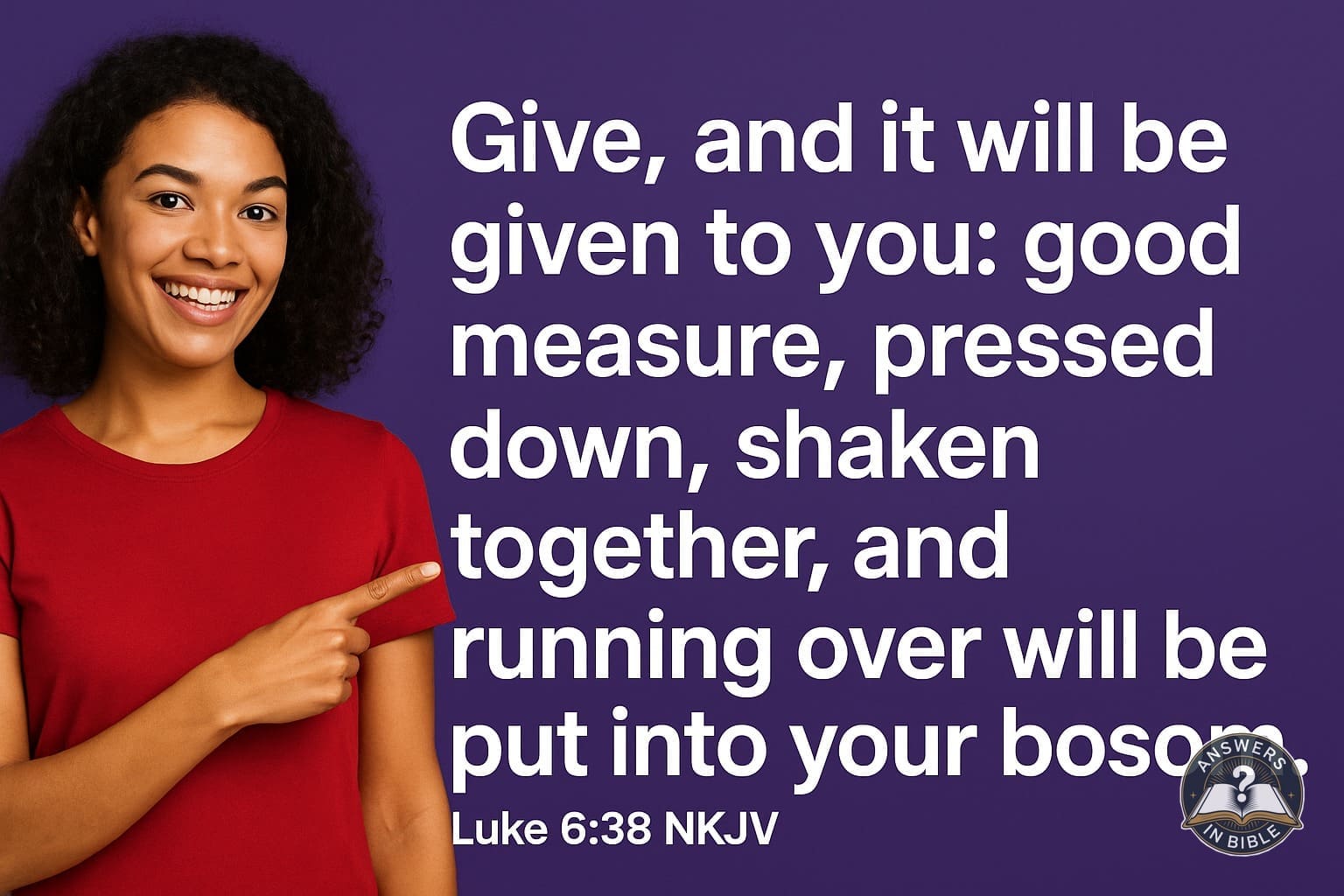

  • Good Measure, Pressed Down | Luke 6:38

    Good Measure, Pressed Down | Luke 6:38

    “Give, and it will be given to you: good measure, pressed down, shaken together, and running over will be put into your bosom” (Luke 6:38, NKJV). This verse describes generosity’s return in vivid, almost excessive terms, pressed down, shaken together, running over.

    This isn’t a formula guaranteeing a specific financial return for every gift. It’s a picture of the generous, abundant character of God’s response to a generous heart.

    The image itself is worth sitting with, not a stingy trickle back, but overflow, more than what was originally given.

    Where has hesitation about giving been rooted in a fear of scarcity, when this verse pictures a God who responds with genuine overflow?

  • Good Questions to Ask a Pastor

    Good Questions to Ask a Pastor

    A good conversation with your pastor can bring clarity to seasons of doubt, growth, or decision-making. Whether you are new to a church, walking through a hard season, or simply want to grow deeper in your faith, knowing what to ask can turn a quick hello into a meaningful conversation. Pastors are shepherds, teachers, and fellow believers who are usually glad to talk through real questions with the people in their church.

    Why It Helps to Ask Your Pastor Questions

    Scripture describes pastors and church elders as shepherds who watch over the people in their care. First Peter 5:2 says leaders are called to “be shepherds of God’s flock that is under your care, watching over them, not because you must, but because you want to.” That posture of care means most pastors welcome honest questions. Asking good questions is not a sign of weak faith. It is often the first step toward a stronger one, and it helps a pastor know how to guide, teach, and pray for the people in their congregation.

    Questions About Faith and Spiritual Growth

    Many conversations with a pastor start with questions about growing closer to God. A few worth asking:

    How can I build a consistent habit of reading the Bible and praying? What spiritual disciplines have helped you grow in your own walk with God? How do I know if I am hearing from God or just my own thoughts? What does it look like to grow in patience, humility, or forgiveness in daily life? These kinds of questions invite a pastor to share both biblical guidance and personal experience, which is often where the most helpful answers come from.

    Questions About Church Life and Leadership

    Hebrews 13:17 encourages believers to “have confidence in your leaders and submit to their authority, because they keep watch over you as those who must give an account.” Understanding how a church is led and cared for can deepen that trust. Consider asking: How does our church make major decisions? What is our church’s vision for the next few years? How can I get more involved or serve using my gifts? Who should I talk to if I am struggling with something in the church community? A pastor’s answers to these questions can help you feel more connected to the life of the church, not just a visitor to it.

    Questions to Ask During a Difficult Season

    James 5:14 reminds believers that in hard times, “let them call the elders of the church to pray over them.” Pastors are often the first people believers turn to during grief, illness, doubt, or major life decisions. Helpful questions for these seasons include: What does the Bible say about suffering or loss? How can I keep trusting God when I do not understand what is happening? Would you be willing to pray with me about this? Are there other people in the church who have walked through something similar? A pastor cannot answer every question with certainty, but a caring conversation can offer comfort, perspective, and practical next steps.

    Key Bible Verses

    Hebrews 13:17 (NIV): “Have confidence in your leaders and submit to their authority, because they keep watch over you as those who must give an account. Do this so that their work will be a joy, not a burden, for that would be of no benefit to you.”

    1 Peter 5:2 (NIV): “Be shepherds of God’s flock that is under your care, watching over them, not because you must, but because you want to; not pursuing dishonest gain, but eager to serve.”

    James 5:14 (NIV): “Is anyone among you sick? Let them call the elders of the church to pray over them and anoint them with oil in the name of the Lord.”

    Frequently Asked Questions

    Is it okay to ask my pastor hard or doubtful questions?

    Yes. Most pastors would rather hear an honest doubt than have someone quietly walk away from their faith. Bringing real questions to a pastor is a normal, healthy part of spiritual growth, not a sign that something is wrong with your faith.

    What if I do not have a regular pastor to ask?

    If you are between churches, exploring faith on your own, or simply want to think through a question right now, you can bring it to the Ask the Bible tool at Answers In Bible and get a scripture-based answer any time.

    Related Bible Topics

    Ask a Deeper Question

    Have a question you would like to explore further? Ask the Bible any question and get an instant, scripture-based answer.

  • His Mercy Endures Forever | Psalm 107:1

    His Mercy Endures Forever | Psalm 107:1

    “Oh, give thanks to the LORD, for He is good! For His mercy endures forever” (Psalm 107:1, NKJV). This verse pairs thanksgiving directly with two reasons, God’s goodness and His enduring mercy, not vague positivity but specific cause.

    Endures forever rules out mercy as a temporary, occasional gift. It’s described as continuous, not something that runs out or gets revoked.

    This is a good verse to return to on any day when gratitude doesn’t come naturally. The reasons given don’t depend on your current circumstances feeling good.

    What specific evidence of God’s enduring mercy in your own life could anchor genuine thanksgiving today, regardless of how the day is going?

  • What Are the Fruits of the Spirit?

    What Are the Fruits of the Spirit?

    The fruits of the Spirit are the nine character traits the Bible says grow naturally in a life shaped by God’s Spirit. They are not a checklist to force or a personality to fake. According to Galatians 5:22-23, they are the natural “fruit” that appears over time when someone walks closely with God, much like fruit grows on a healthy tree without the tree straining to produce it.

    What Are the Fruits of the Spirit?

    The apostle Paul lists them in Galatians 5:22-23 (NKJV): “But the fruit of the Spirit is love, joy, peace, longsuffering, kindness, goodness, faithfulness, gentleness, self-control. Against such there is no law.” Notice the word is singular, “fruit,” not “fruits,” even though nine qualities are named. The idea is that these traits grow together as one connected harvest, not as separate gifts a person picks and chooses among.

    Paul writes this passage as a contrast to what he calls “the works of the flesh” a few verses earlier, things like hatred, jealousy, and selfish ambition. Where those traits come from self-effort and self-interest, the fruit of the Spirit comes from a life increasingly led by God’s Spirit rather than by willpower alone.

    How Does This Fruit Grow?

    Jesus uses a similar picture in John 15:5, describing Himself as a vine and His followers as branches: “I am the vine, you are the branches. He who abides in Me, and I in him, bears much fruit; for without Me you can do nothing.” The emphasis is on staying connected, not on trying harder. A branch does not force fruit into existence by effort; it simply stays attached to the vine, and the fruit follows as a result.

    Practically, this means the fruit of the Spirit tends to grow through ordinary, unglamorous habits: prayer, reading scripture, honest community with other believers, and simply staying in relationship with God through the everyday ups and downs of life. It is less like flipping a switch and more like tending a garden season after season.

    Why These Nine Traits Matter

    Together, love, joy, peace, patience, kindness, goodness, faithfulness, gentleness, and self-control describe what a Spirit-led life looks like both toward God and toward other people. Some, like love and joy, describe an inward posture. Others, like kindness and gentleness, describe how that posture shows up in relationships. Self-control, listed last, describes the steadiness that holds it all together under pressure. Paul adds a striking note at the end of verse 23: “against such there is no law.” No rule needs to restrain a life that is already producing this kind of fruit.

    Key Bible Verses

    Galatians 5:22-23 (NKJV): “But the fruit of the Spirit is love, joy, peace, longsuffering, kindness, goodness, faithfulness, gentleness, self-control. Against such there is no law.”

    John 15:5 (NKJV): “I am the vine, you are the branches. He who abides in Me, and I in him, bears much fruit; for without Me you can do nothing.”

    Galatians 5:16 (NKJV): “I say then: Walk in the Spirit, and you shall not fulfill the lust of the flesh.”

    Frequently Asked Questions

    Are the fruits of the Spirit gifts, like spiritual gifts?

    No. Spiritual gifts (like teaching or prophecy, described in passages such as 1 Corinthians 12) are abilities given for serving others, and different believers receive different gifts. The fruit of the Spirit is different: it describes character, and scripture presents all nine traits as the shared aim for every believer, not a specialty for some.

    What if I don’t feel like I have all nine traits?

    That is a common and honest experience. Fruit grows gradually, not all at once, and different seasons of life bring different traits to the surface. Galatians 5:22-23 describes a direction to grow toward through an ongoing relationship with God, not a pass-or-fail test to meet immediately.

    Related Bible Topics

    For more on living out these qualities in everyday life, see What Does Faith Without Works Mean?, What Is the Greatest Commandment in the Bible?, and What Does the Bible Say About Envy?

    Ask a Deeper Question

    Have a follow-up question about the fruits of the Spirit or another passage of scripture? Ask below and get a thoughtful, Bible-based answer.

  • If the Ax Is Dull | Ecclesiastes 10:10

    If the Ax Is Dull | Ecclesiastes 10:10

    “If the ax is dull, and one does not sharpen the edge, then he must use more strength; But wisdom brings success” (Ecclesiastes 10:10, NKJV). A dull ax can still cut, eventually, with enough force. But wisdom would simply sharpen it first.

    This is a picture of unnecessary effort, brute force compensating for a lack of preparation that wisdom would have addressed directly.

    It’s worth asking where you’ve been using more strength than necessary simply because you haven’t taken time to sharpen the tool, skill, or approach first.

    What dull ax in your own life is currently requiring more strength than it should, that a little wisdom and preparation could sharpen instead?

  • Do Not Rejoice When Your Enemy Falls | Proverbs 24:17

    Do Not Rejoice When Your Enemy Falls | Proverbs 24:17

    “Do not rejoice when your enemy falls, And do not let your heart be glad when he stumbles” (Proverbs 24:17, NKJV). This is a hard instruction because the instinct to celebrate an enemy’s downfall feels so natural, even justified.

    This verse asks for something harder than mere restraint from public gloating. It asks the heart itself not to be glad.

    That’s a deeper standard than most of us hold ourselves to. Public composure is one thing. An actually ungladdened heart is another.

    Has an enemy’s recent stumble quietly gladdened your heart in a way this verse calls you to examine honestly?

  • The Future of That Man Is Peace | Psalm 37:37

    The Future of That Man Is Peace | Psalm 37:37

    “Mark the blameless man, and observe the upright; For the future of that man is peace” (Psalm 37:37, NKJV). Mark and observe suggest deliberate attention, actually watching how an upright life unfolds over time, not just in a single moment.

    The promise attached, future is peace, isn’t about an easy life free from hardship. It’s about where an upright path eventually leads.

    This is worth taking as encouragement for anyone currently walking uprightly through a hard season without much visible reward yet.

    Who in your own life models this kind of blameless, upright pattern that you could learn from by actually marking and observing them?

  • 3 Simple Ways to Practice Gratitude Daily

    3 Simple Ways to Practice Gratitude Daily

    Gratitude doesn’t usually arrive automatically, it grows through practice. Here are three simple ways to build it into your everyday rhythm this week.

    1. Name three specific things each night

    Before bed, name three specific things from the day you’re grateful for, not vague categories, but specific moments. Specificity trains the mind to actually notice good things as they happen, not just look for them retroactively.

    2. Thank someone directly, out loud, once a day

    Find one person each day to thank directly and specifically, not a generic thanks, but naming exactly what you appreciated. This builds gratitude as an active practice, not just a private feeling.

    3. Write one thank-you note a week

    A short, handwritten note to someone who’s shaped your life takes only a few minutes but tends to leave a lasting impression, both for the person receiving it and for the gratitude it builds in you.

    None of these require major life changes, just small, repeated choices that train the heart toward gratitude rather than leaving it to chance.

  • Bible Verses for Healing

    Bible Verses for Healing

    When illness or pain enters life, many people instinctively turn to scripture, searching for Bible verses about healing. Whether the need is physical, emotional, or spiritual, the Bible speaks often about God’s care for the suffering and His power to restore. Here are some of the most meaningful passages on healing, along with an honest look at how sincere Christians understand them differently.

    Verses That Show God as Healer

    Scripture repeatedly describes God as a healer, both of the body and of the heart. In Exodus 15:26, God identifies Himself directly to His people: “for I am the LORD who heals you.” The psalms echo this theme. Psalm 103:2-3 calls believers to “forget not all His benefits,” including that He “heals all your diseases.” Psalm 147:3 adds that God “heals the brokenhearted and binds up their wounds,” a reminder that healing in scripture is not limited to physical sickness but extends to grief and emotional pain as well.

    Verses About Praying for Healing

    The Bible also gives believers direct instruction on how to pray when facing sickness. James 5:14-15 tells the sick to “call for the elders of the church” to “pray over him, anointing him with oil in the name of the Lord,” promising that “the prayer of faith will save the sick.” Jeremiah 17:14 offers a simple, personal prayer: “Heal me, O LORD, and I shall be healed; save me, and I shall be saved, for You are my praise.” These passages present prayer as a natural response to illness, not a last resort.

    How Christians Understand Healing Differently

    Not every sincere, Bible-believing Christian reads these promises the same way, and it is worth being honest about that. Some Christians, particularly in charismatic and Pentecostal traditions, emphasize that God still heals miraculously today in direct answer to prayer, pointing to verses like James 5:15 as a standing promise. Others, often in more cessationist traditions, emphasize that physical healing is not always immediate or guaranteed in this life, and that ultimate healing is fulfilled spiritually or in the resurrection, pointing to passages like Isaiah 53:5, which speaks of being “healed” through Christ’s suffering in a way many understand to include spiritual healing from sin alongside physical restoration. Both perspectives take scripture seriously and affirm that God cares deeply about suffering people. Where they differ is on the timing and form healing takes in this life, a question this site does not take a side on.

    Key Bible Verses

    Psalm 103:2-3 — “Bless the LORD, O my soul, and forget not all His benefits: who forgives all your iniquities, who heals all your diseases.”

    Jeremiah 17:14 — “Heal me, O LORD, and I shall be healed; save me, and I shall be saved, for You are my praise.”

    James 5:14-15 — “Is anyone among you sick? Let him call for the elders of the church, and let them pray over him, anointing him with oil in the name of the Lord. And the prayer of faith will save the sick, and the Lord will raise him up. And if he has committed sins, he will be forgiven.”

    Frequently Asked Questions

    Does the Bible promise physical healing to everyone who prays?

    The Bible records many instances of physical healing and gives instructions for praying for the sick, but it does not present a single formula guaranteeing a specific outcome every time. Christians differ on how to understand this, and this site presents the range of sincere views rather than a single answer.

    What does it mean that Christians are healed “by His stripes”?

    Isaiah 53:5 says believers are “healed” through Christ’s suffering. Some Christians apply this primarily to spiritual healing from sin, others also apply it to physical healing, and many hold both together. It is one of the more debated healing verses among faithful believers.

    Related Bible Topics

    Ask a Deeper Question

    Have a question about healing, prayer, or another topic in scripture? Ask below and get a thoughtful, Bible-based response.